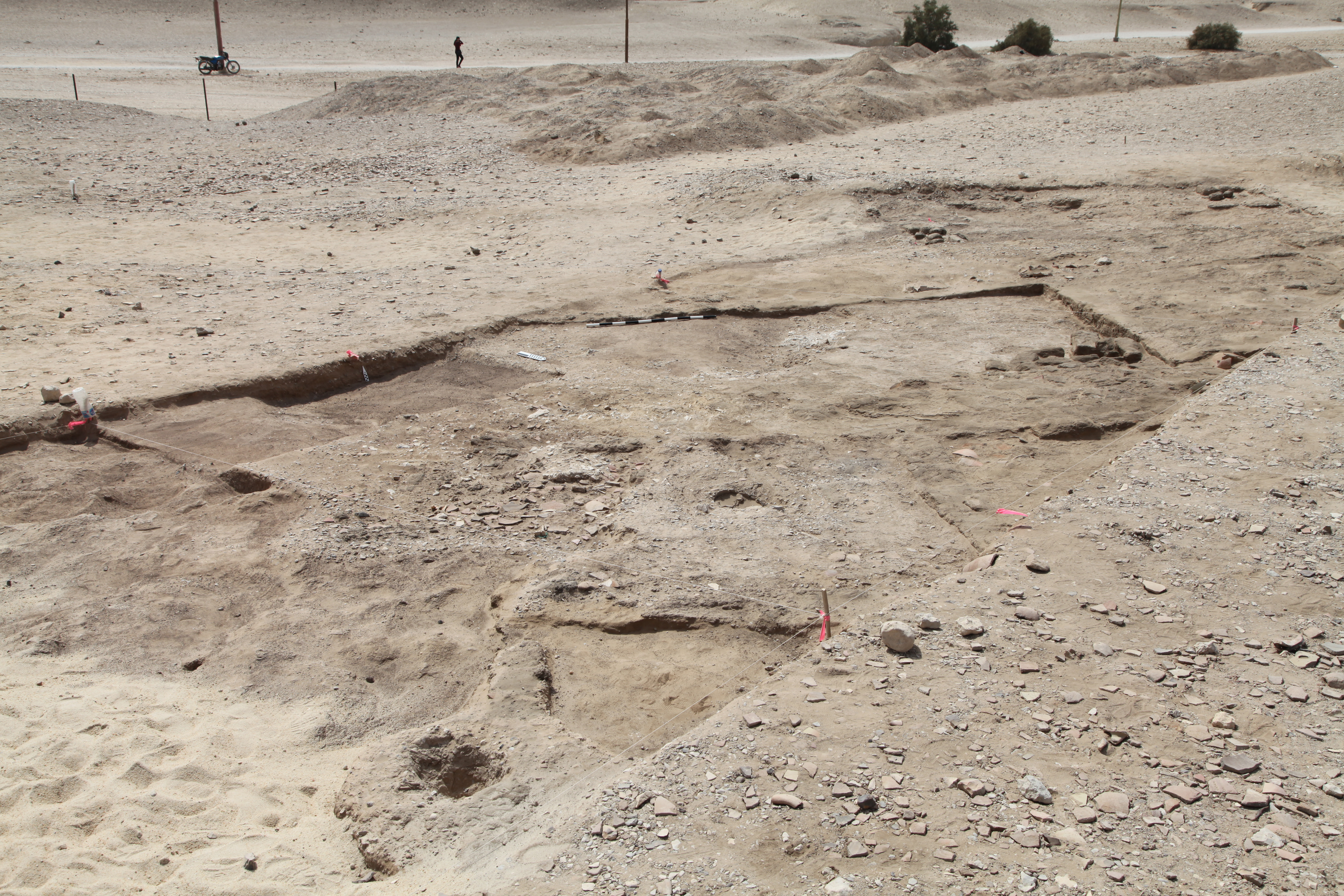
As promised, a short report on new architecture in the West Settlement: we do have more “walls” (still generally only one brick high, but clearly outlining built structures laid out along a NE-SW grid) in the West Settlement. These line up with walls uncovered in earlier seasons, and also connect with ones excavated by Barry Kemp in the 1970s. The wadi has washed out anything that might have remained to the east (What Lies Beneath), but the settlement does continue to the west and perhaps also to the north, and promises to yield more information in future seasons.
N140 line: looking southwest over squares excavated in 2019
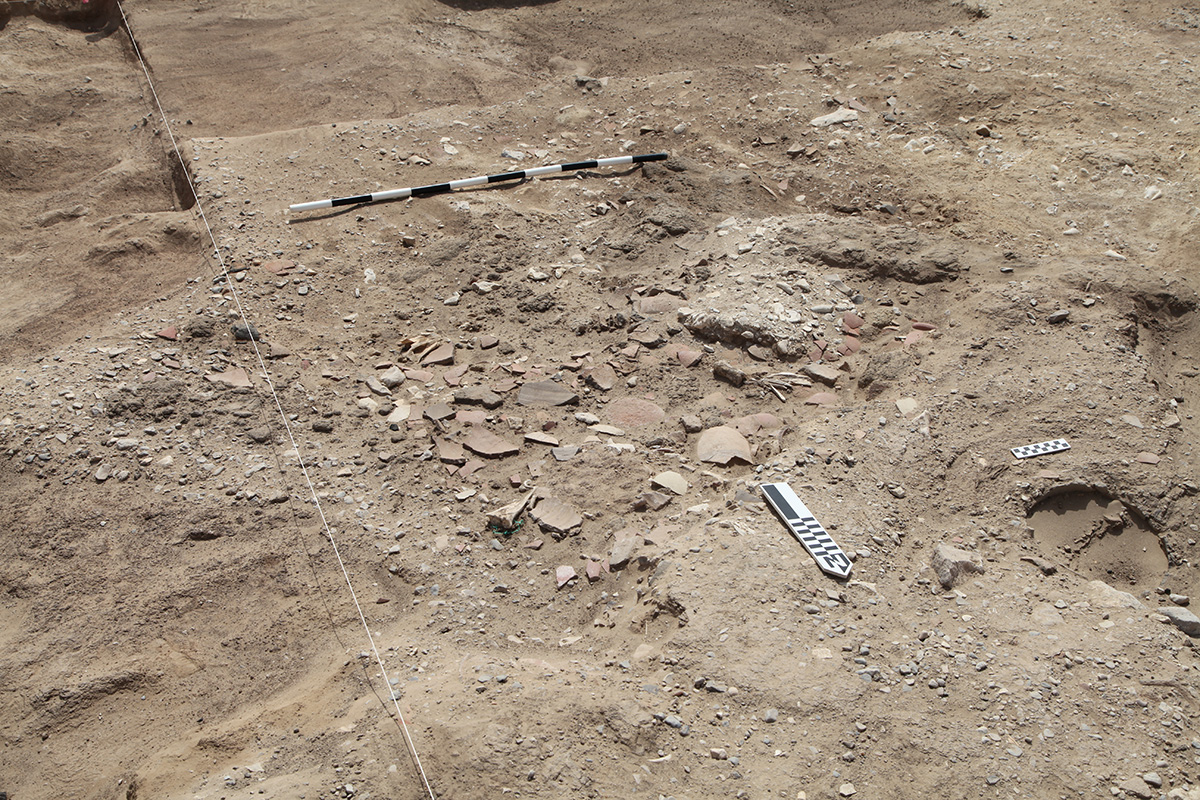
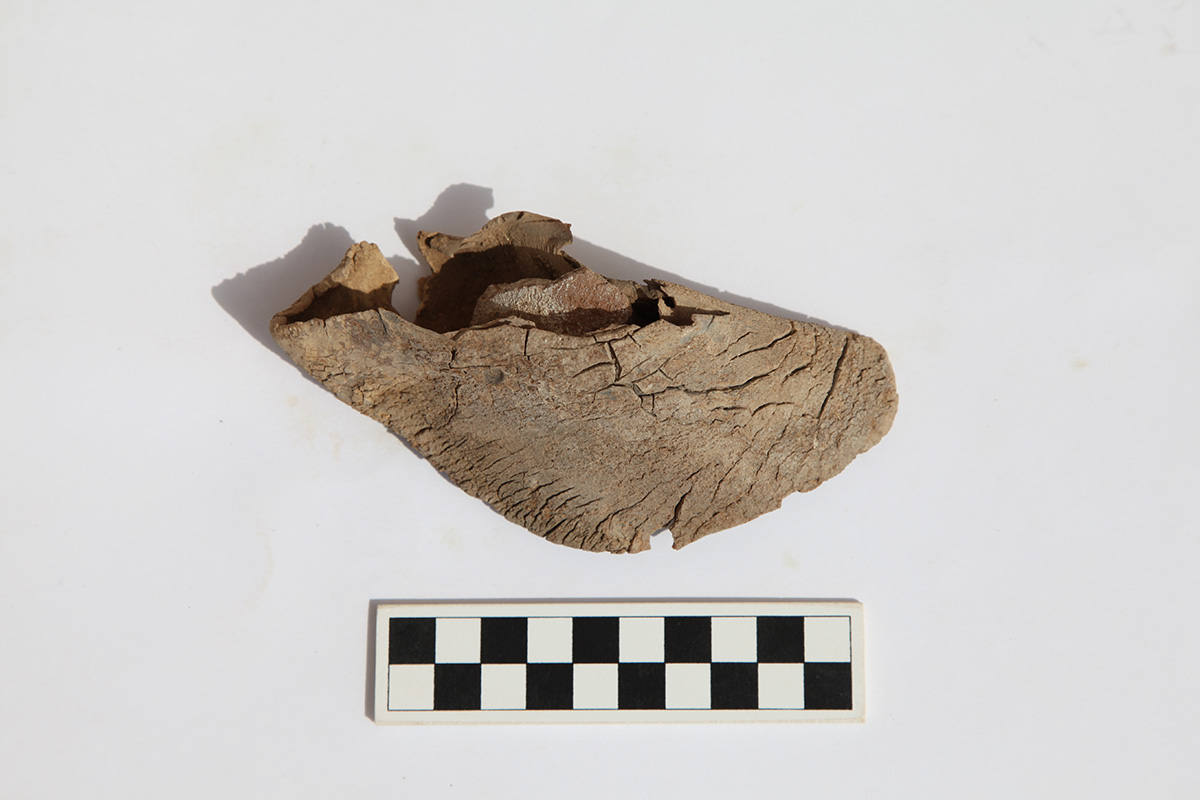
But today’s blog is about our “midden.” We have uncovered a large (about 2 and a half meters in diameter) deposit that spans the border between two of our squares, an area we are calling Feature 201. On the surface, this looked like the usual sort of sherd scatter, but as we began to clean and clear, we discovered that it continued for a several levels, and was thick with large and small sherds and lots of faunal remains. These include bones of various sizes, bits of hide, and even several parts of hooves.
N140/E115: looking south over Feature 201
A preliminary look at the pottery (with which we have filled 26 of our yellow bags so far) suggests a higher percentage of the elite “Palace” ware than we’ve found in most of the rest of the site, although we will need to analyze it properly before coming to any conclusions.
JEMWS.2019.B40: Keratin of the hoof of a ruminant (identification courtesy of Salima Ikram)
This is larger than other such deposits we have found in previous seasons. It is also not clear how it relates to our architecture – other deposits have tended to be along walls or in corners, or even used as leveling fill under walls (Broken Dishes); this looks like it might go over a wall, although we will need to do more excavation here to find out for sure.
This is an intriguing deposit, and one that is sure to yield interesting and useful information once it has been completely cleared and the material recovered has been studied by our experts.
First of all, spoiler alert. We are finding more
architecture in the West Settlement, but more on that later. In the meantime,
Mahmoud, Ja’allan, and Sa’ad, with assistance from our sharp-eyed junior
workmen, continue to find bits and pieces of this and that among the sherds and
bones — a bead here, part of a ring shank there, and of course pottery
everywhere. It’s especially interesting to see what lies in the sterile levels
just above what we consider the desert surface – the other day we found bits of
a very dead and dried out scorpion, a small egg of some sort, and some pieces
of very modern-looking bread.
Today, Mahmoud was working in a promising looking deposit of
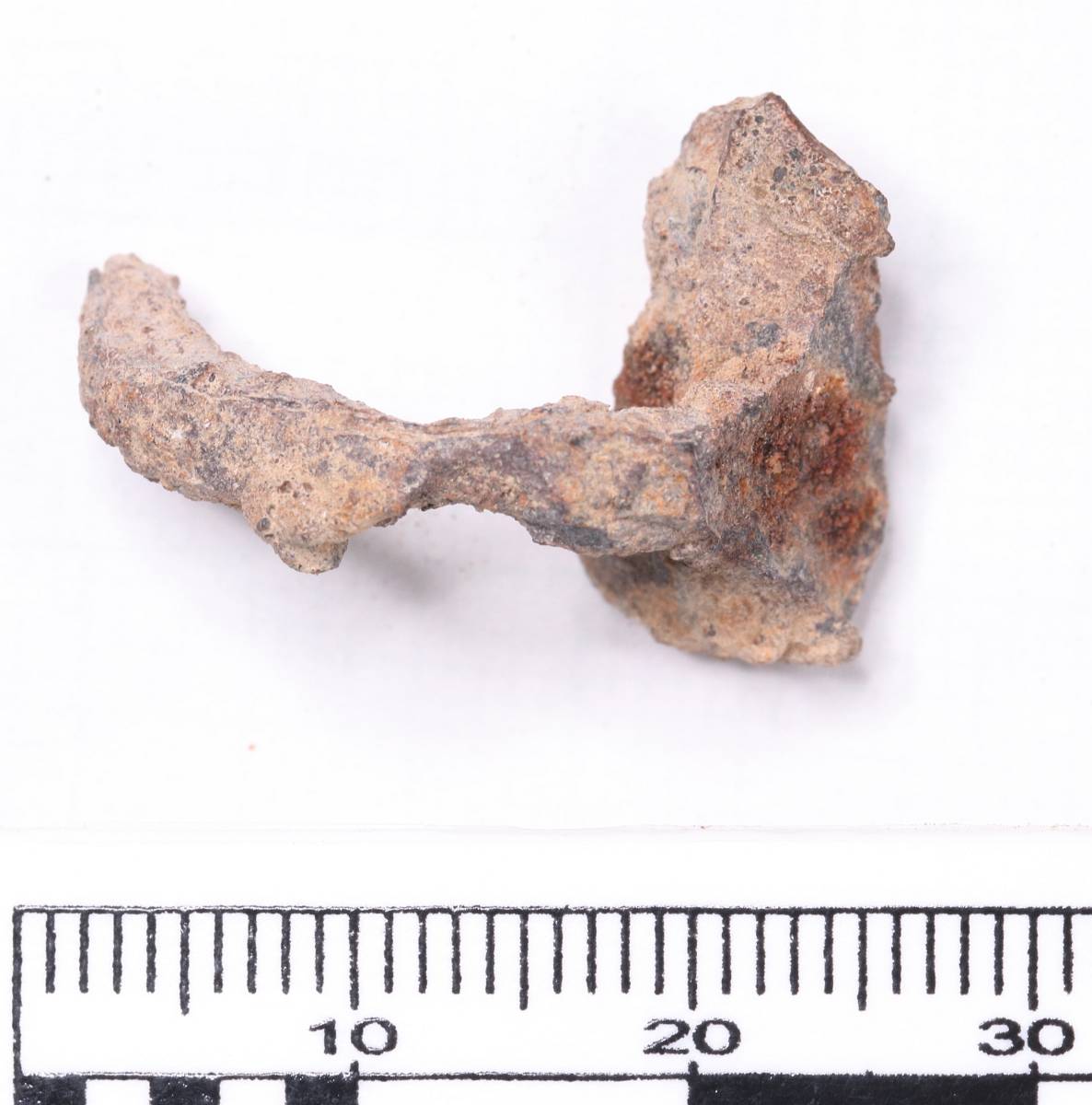
sherds near the surface, and found this very interesting object.
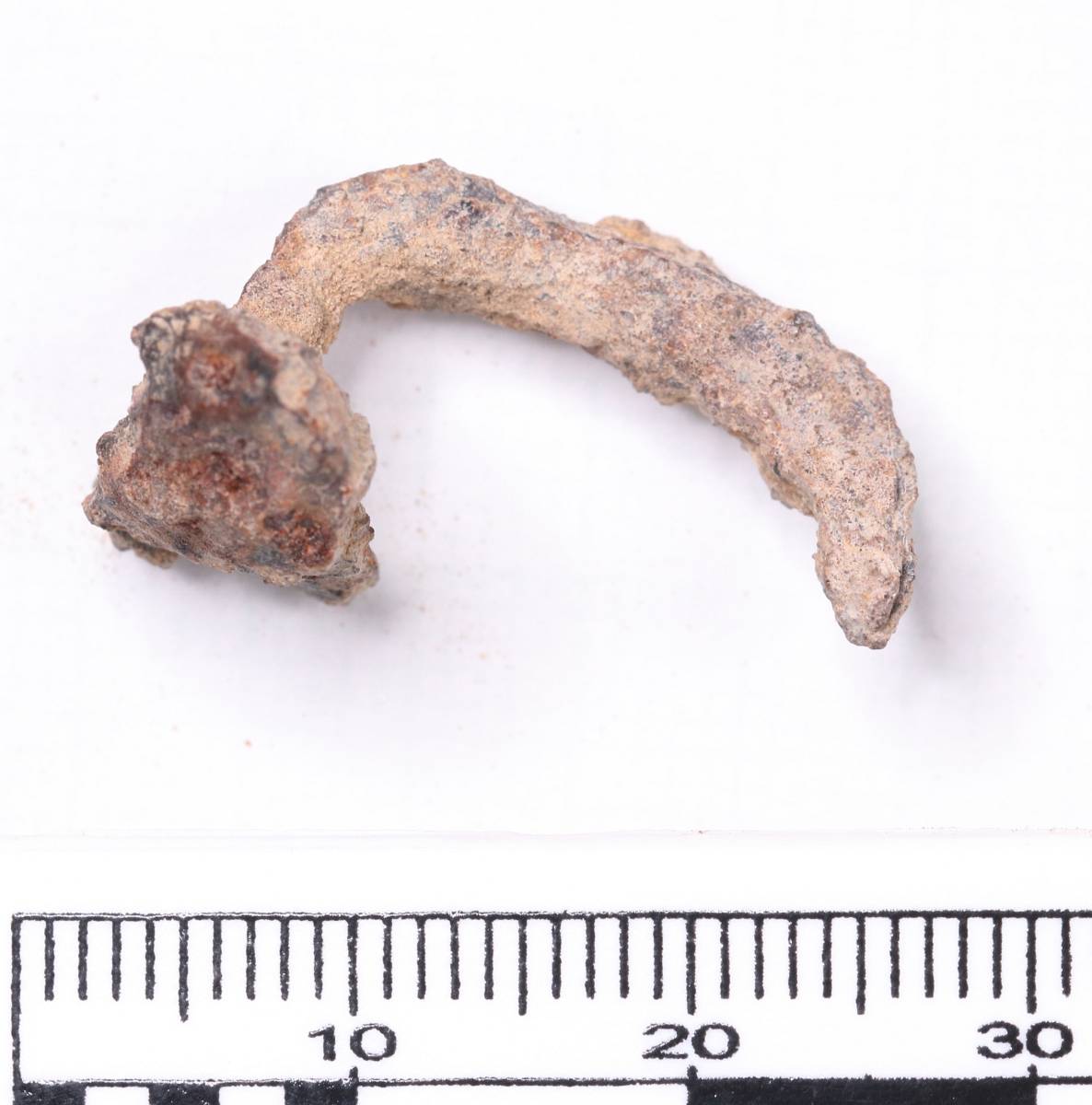
Our “handle,” JEMWS.2019.16
It seems to be made out of some sort of metal, and looked at first like perhaps it was a handle from a small vessel. But that didn’t really make sense, so I took it to my colleagues over in the Industrial Site for a consultation. We looked at it together, and Diana noticed the red color indicating rust. So we were able to rule out immediately that it was ancient, since iron would not have been used for any sort of vessel – the only iron available to the Egyptians at that time was meteoric.
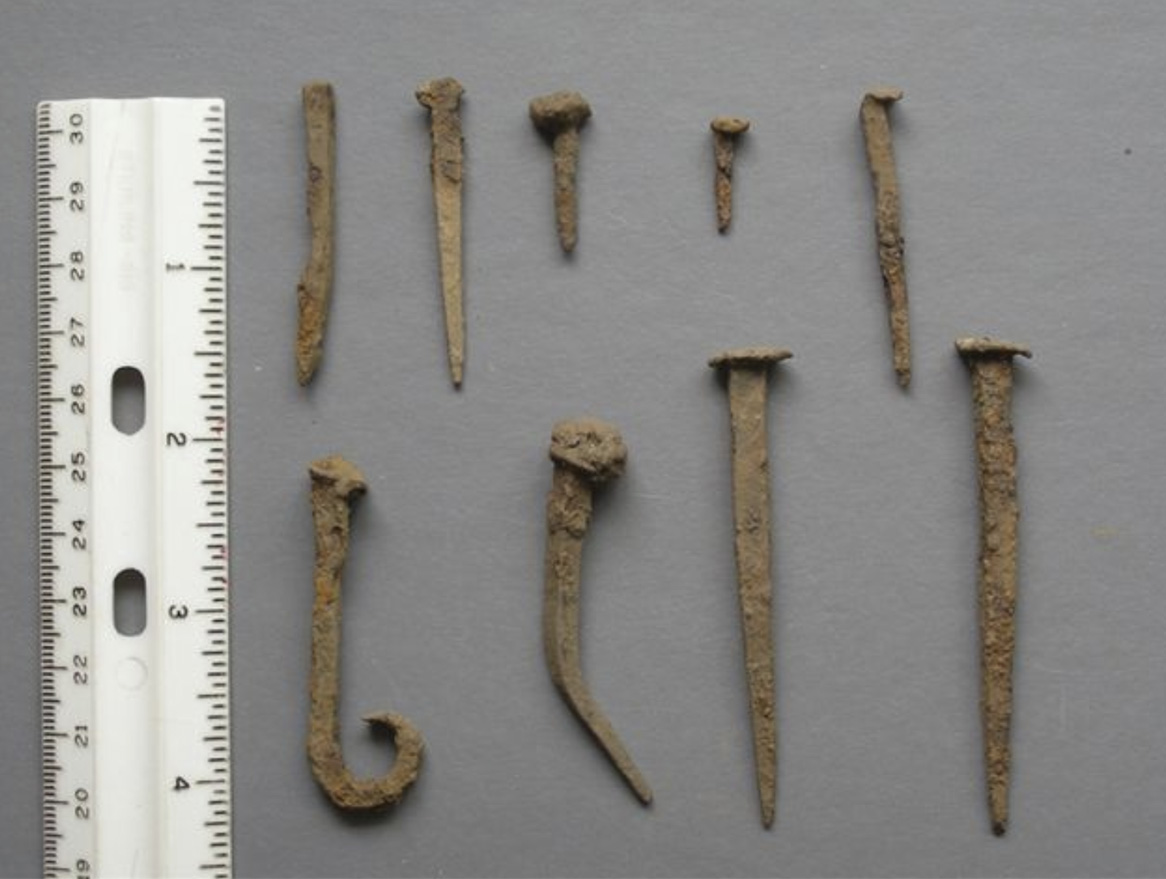
Another view
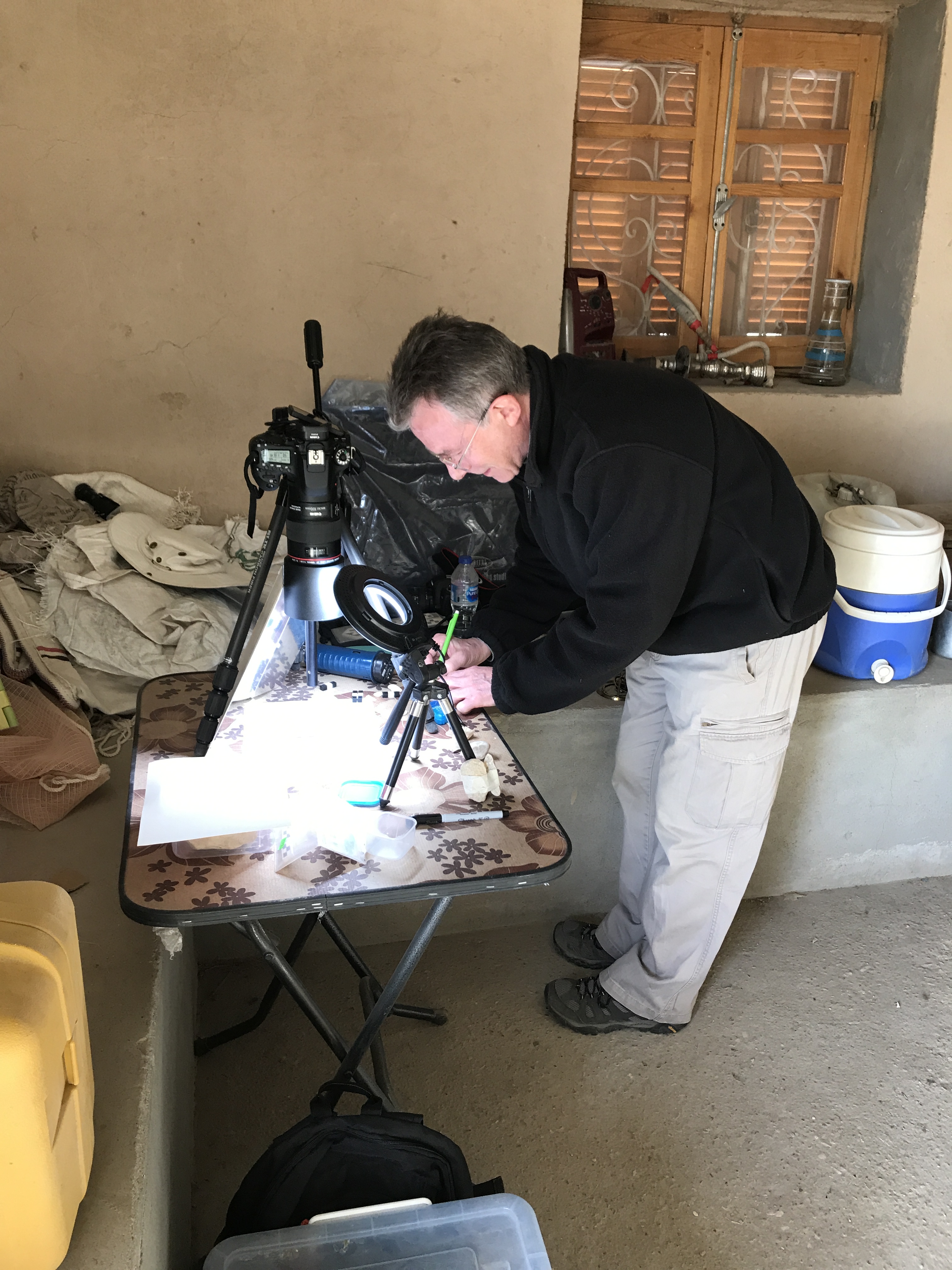
Ivor happened to be there as well, having left his “photo studio” (otherwise known as the guard hut) to take some photographs for Diana. He took one look and suggested that it might be a nail that had gotten bent. We all thought that was a great idea, and Hassan confirmed that it was most likely an old-fashioned nail, no longer used but found in antique furniture and older buildings.
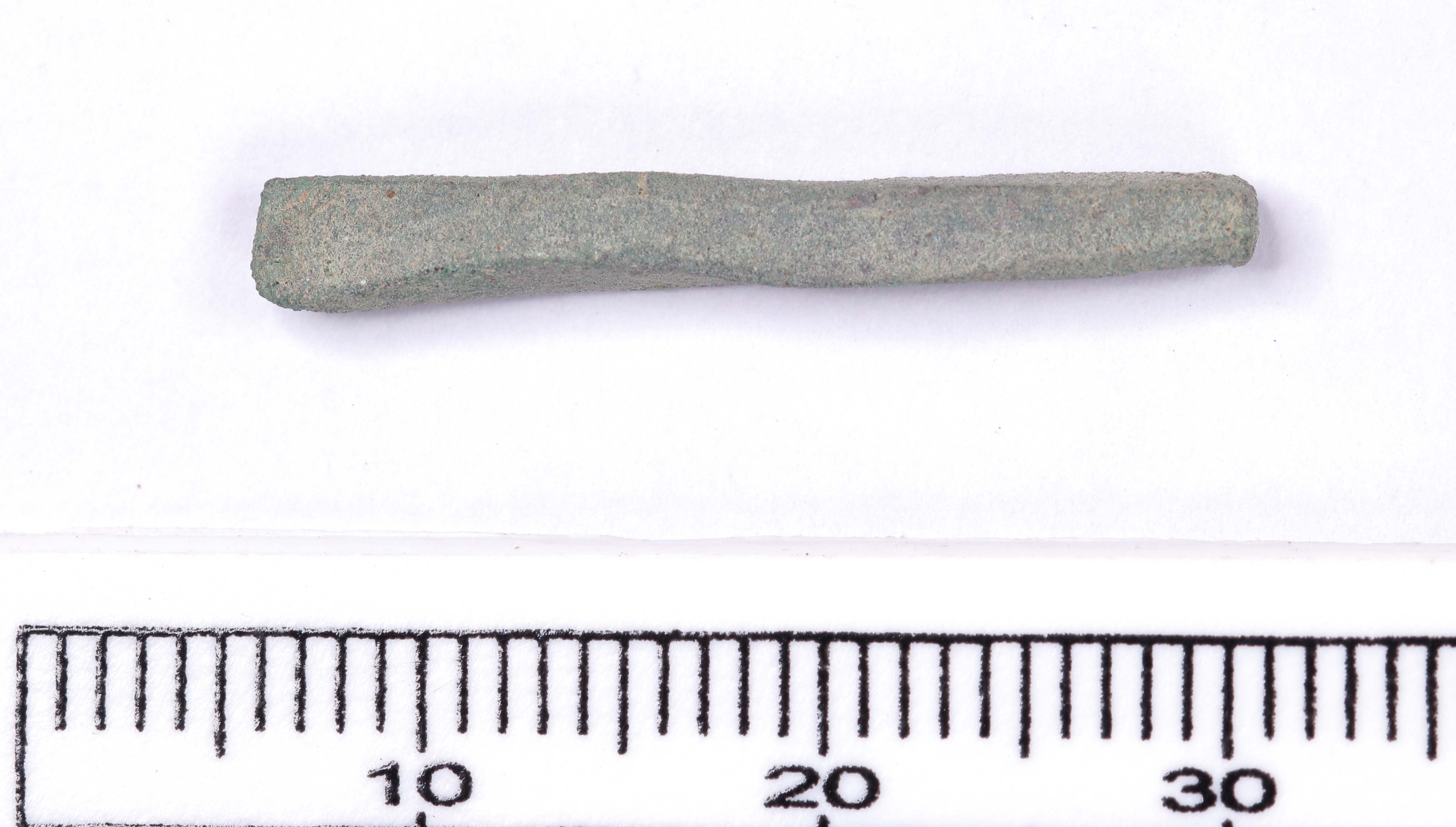
Every season the work at the Industrial Site has produced a wonderful example of a tool. In 2015, almost immediately after opening the first square, we found a perfect flint awl. In 2016 and 2017, we were intrigued by what appeared to be discarded copper alloy drill bits. This year we have a spectacular micro-chisel.
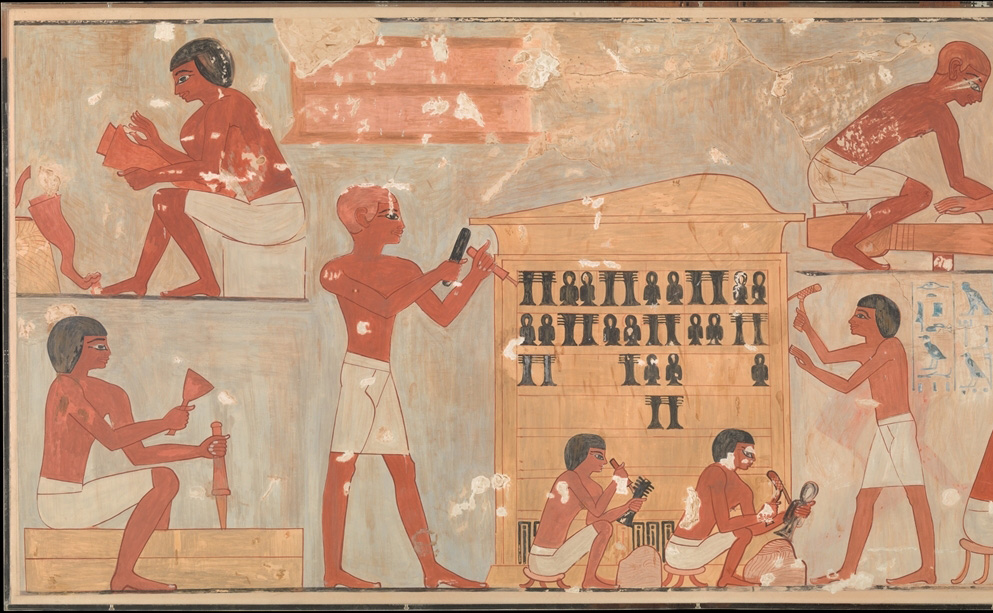
All of us are familiar with chisels. Very practical tools, they can be fashioned with different types of edges that allow a craftsman to accomplish the splitting or cutting of stone, wood, and metal. If the task requires splitting stone or wood, a big chisel is positioned and then hit with a hammer, or in the case of ancient Egypt, probably a wood mallet. When chisels are needed for finer work, the tool is pushed into the material by hand in order to remove what isn’t wanted. The size of the chisel and the style of the edge changes depending on what the work is; smaller chisels are needed for detailed work in wood and other soft materials.
Carpenters at work. Facsimile from the Tomb of Rekhmire, Thebes. Rogers Fund, 1935 (35.101.1)
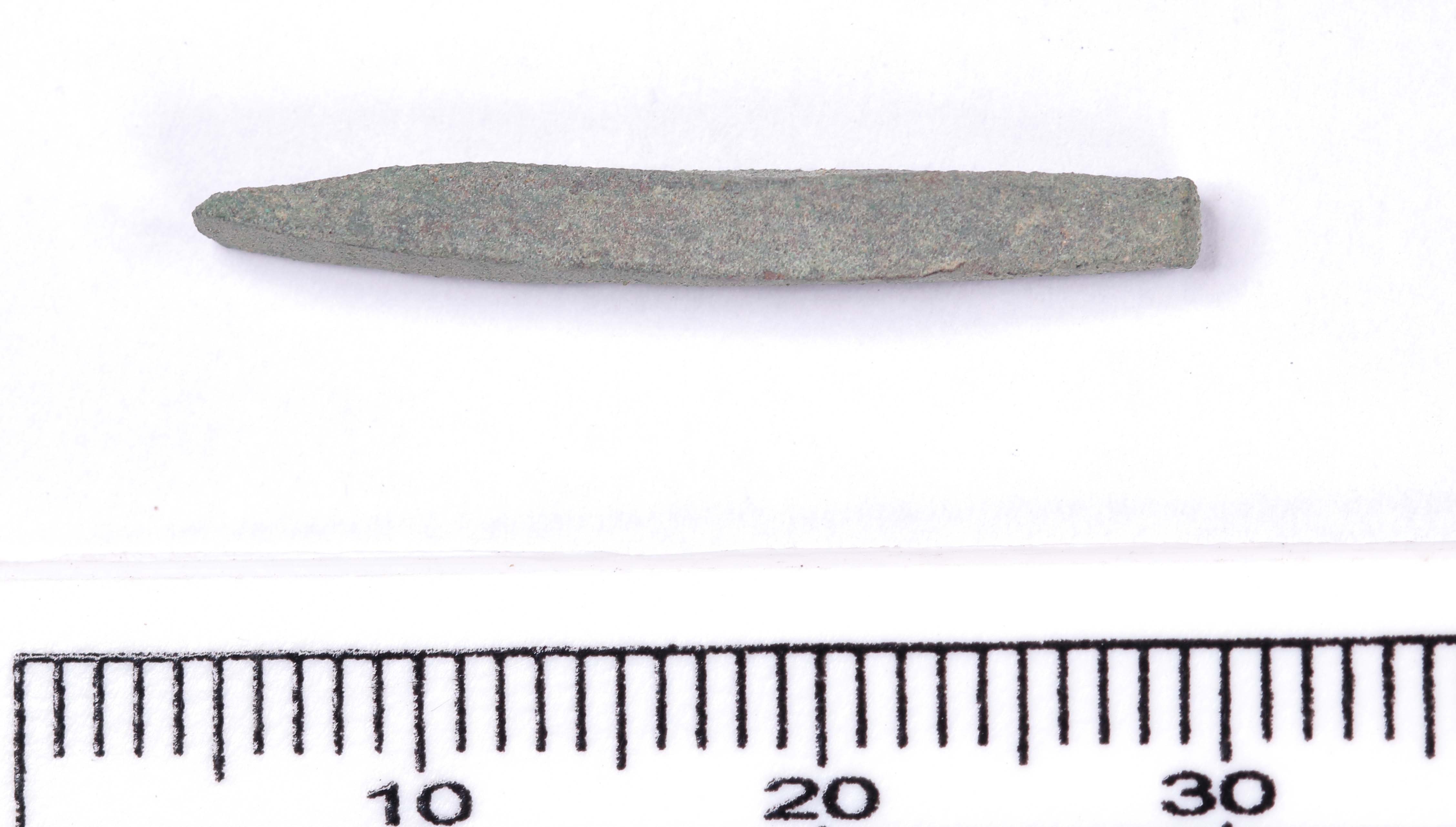
This tiny copper alloy chisel, only 2.5 cm long, is perfectly formed and remarkably preserved. The slightly reduced and rounded proximal end may have been designed as such to be hafted in a small wood handle that would have made it easier to manipulate the tool. The distal end was fashioned into a sharp beveled edge that is somewhat splayed, allowing a craftsman to cut the material cleanly, or to trim or neaten tiny grooves or spaces in the object under manufacture.
View of the chisel (JEMIS.2019.69)Second view of the chisel (JEMWS.2019.69)
We get to pursue our fieldwork in Egypt because of the generosity of the
Ministry of Antiquities. Part of the contract that I sign with them is that a
representative from the Supreme Council of Antiquities will work with us during
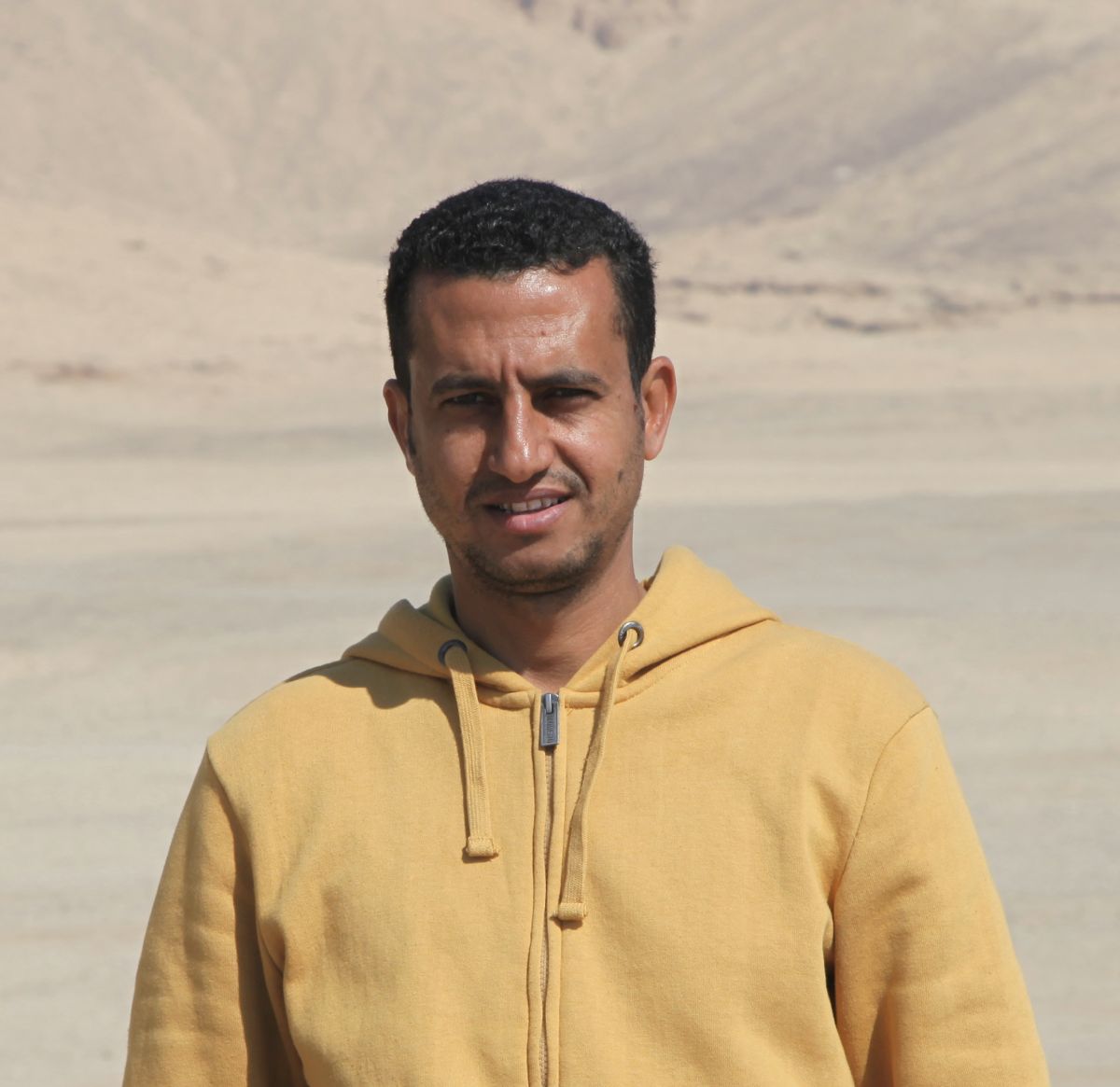
the time we are digging. This year we are lucky to have Mr. Mahmoud Kamal Abu
elWafa. Mr. Mahmoud Kamal comes from
Luxor, specifically Karnak village, so he grew up surrounded by the amazing
antiquities the east bank has to offer. He is a 2009 graduate of Qena
University with a degree in Egyptology. His specialty is New Kingdom history
and he especially likes the large temples of Karnak and Luxor and everything
about the Valley of the Kings.
He joined the SCA in 2012 and has been busy every year. In 2014, he took
part in a field school under Mr. Yasser Mahmoud at Deir el Shelwit, the
Ptolemaic temple in the southern part of Malqata. He worked with the Polish mission at Deir el
Bahri in 2015 and then in 2016 and 2017 worked with the American Research
Center in Egypt, first at TT110, a decorated tomb of a royal butler named
Djehuty, and then in painted New Kingdom tombs in Dra Abu Naga.
We are delighted Mr. Mahmoud decided he wanted to join the Malqata team
this year and we look forward to working with him for the next ten days.
Archaeology requires the systematic collection of objects that were either made, modified, or used by people. By studying these material remains in relation to the environment in which they were produced, archaeologists attempt to understand the lives of those who used them. The process of collecting artifacts may appear somewhat tedious, but it is anything but that. Processing is a crucial part of an archaeological excavation.
This season as the archaeological assistant for the Industrial Site, I am working alongside Diana and Jan to help process all of the objects that are uncovered. As we continue to look for the production center of the glass and faience industry, we are finding manufacturing byproducts including molds, crucible fragments, and vitreous material, which are fragments of glass and faience. Our team follows a very specific method for processing these discoveries.
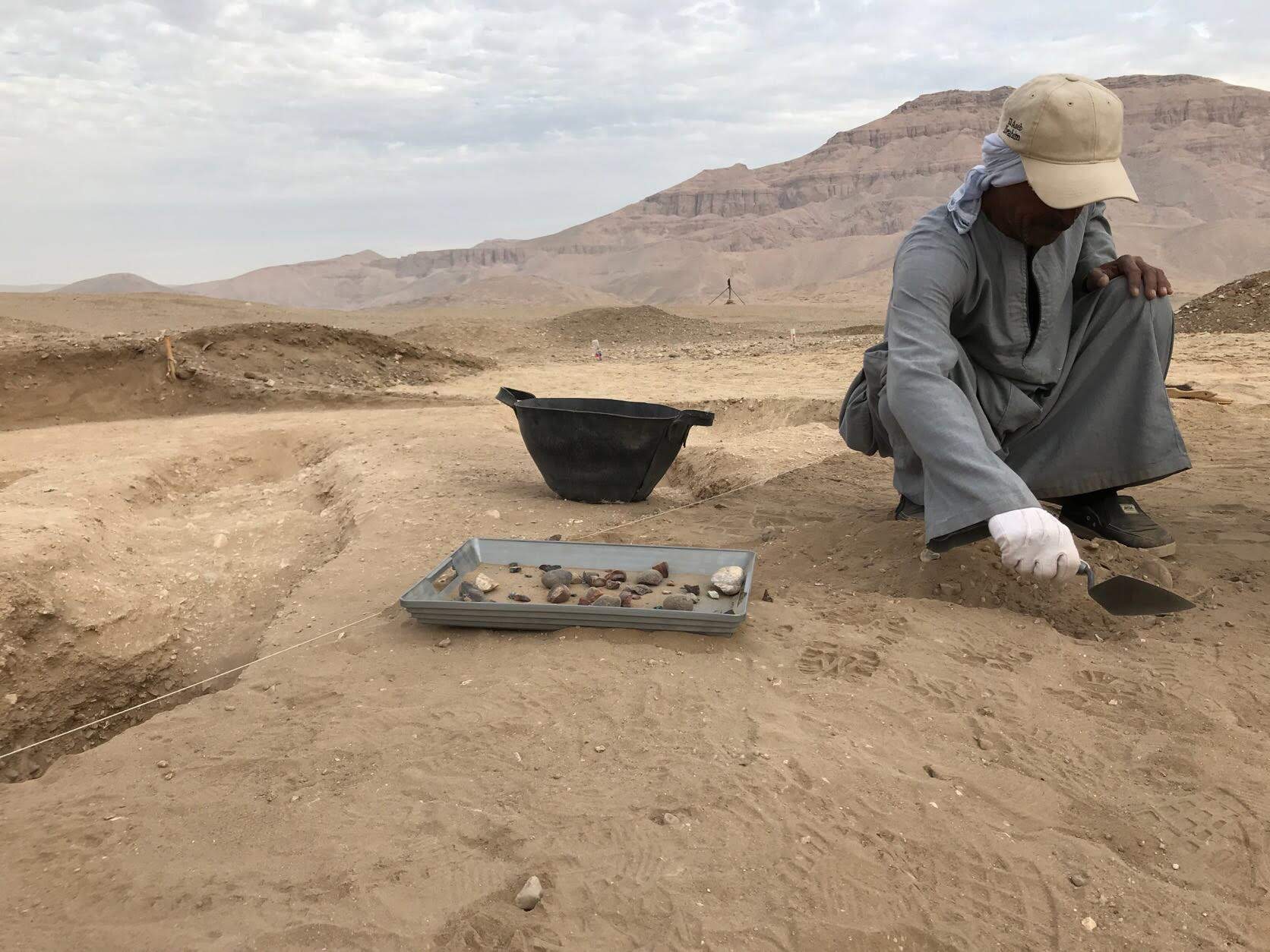
Senior excavator, Azib, working in the Industrial Site
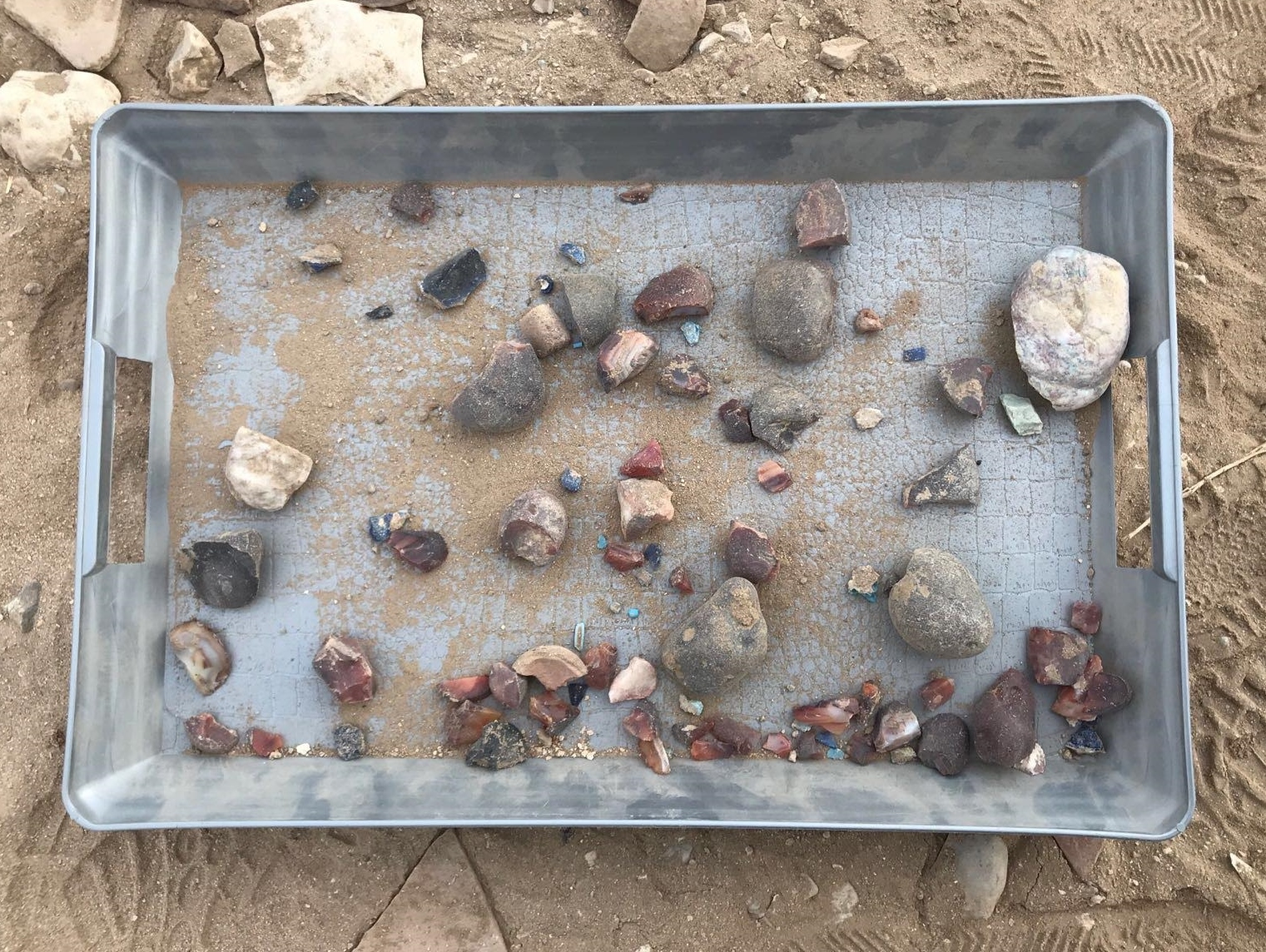
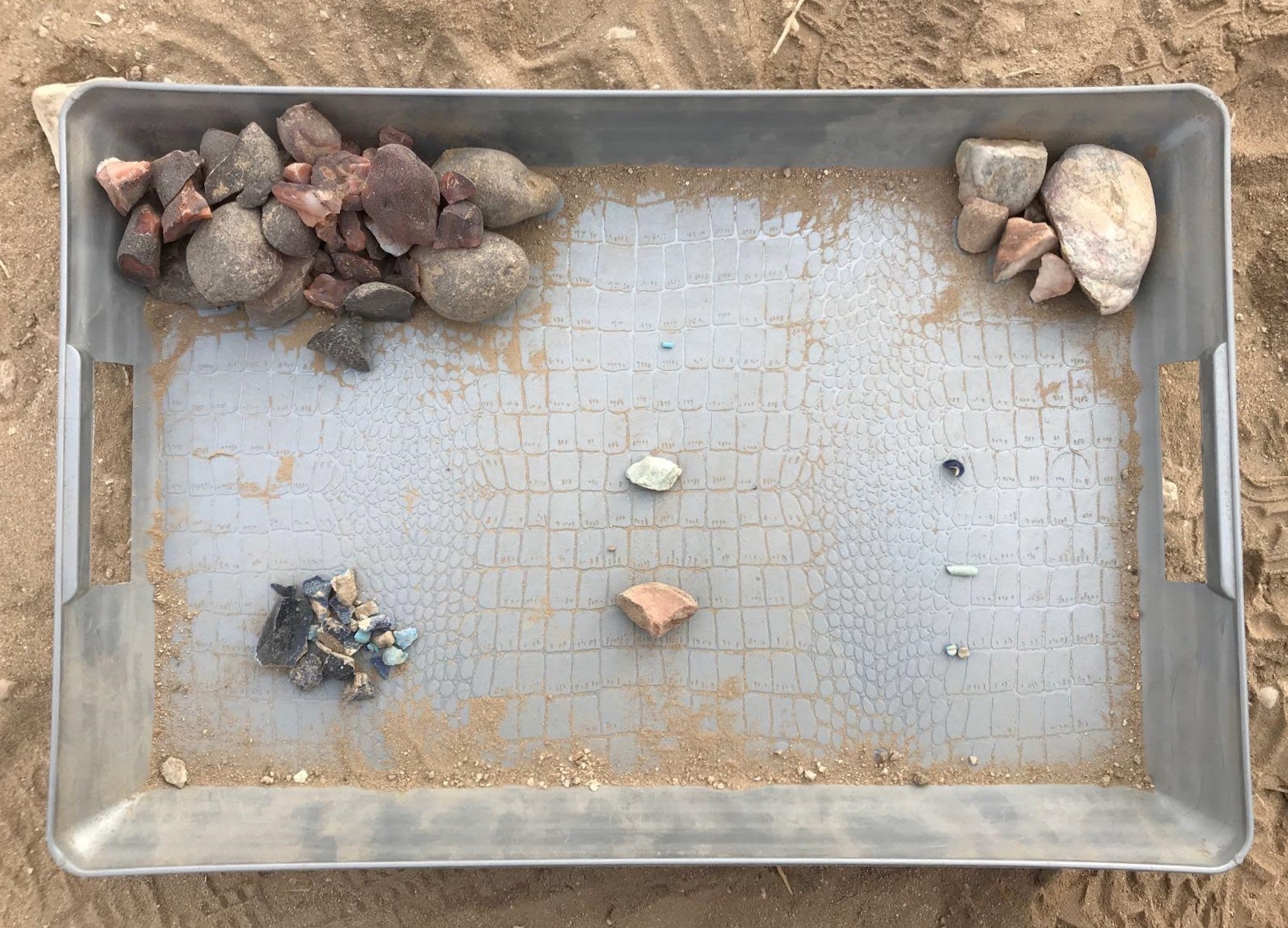
As our workmen excavate methodically by layer or level depending on the context, they set aside all of the finds onto a tray. These artifacts are then sorted by type. At the Industrial Site, all of the material can be divided into two major categories, manufacturing debris and objects. All of the material that has been worked or used by ancient craftsmen gets bagged. However, the process for the two types of finds varies slightly.
Left: An unsorted tray of finds from the Industrial Site. Right: The same tray from the left, after being sorted by object type.
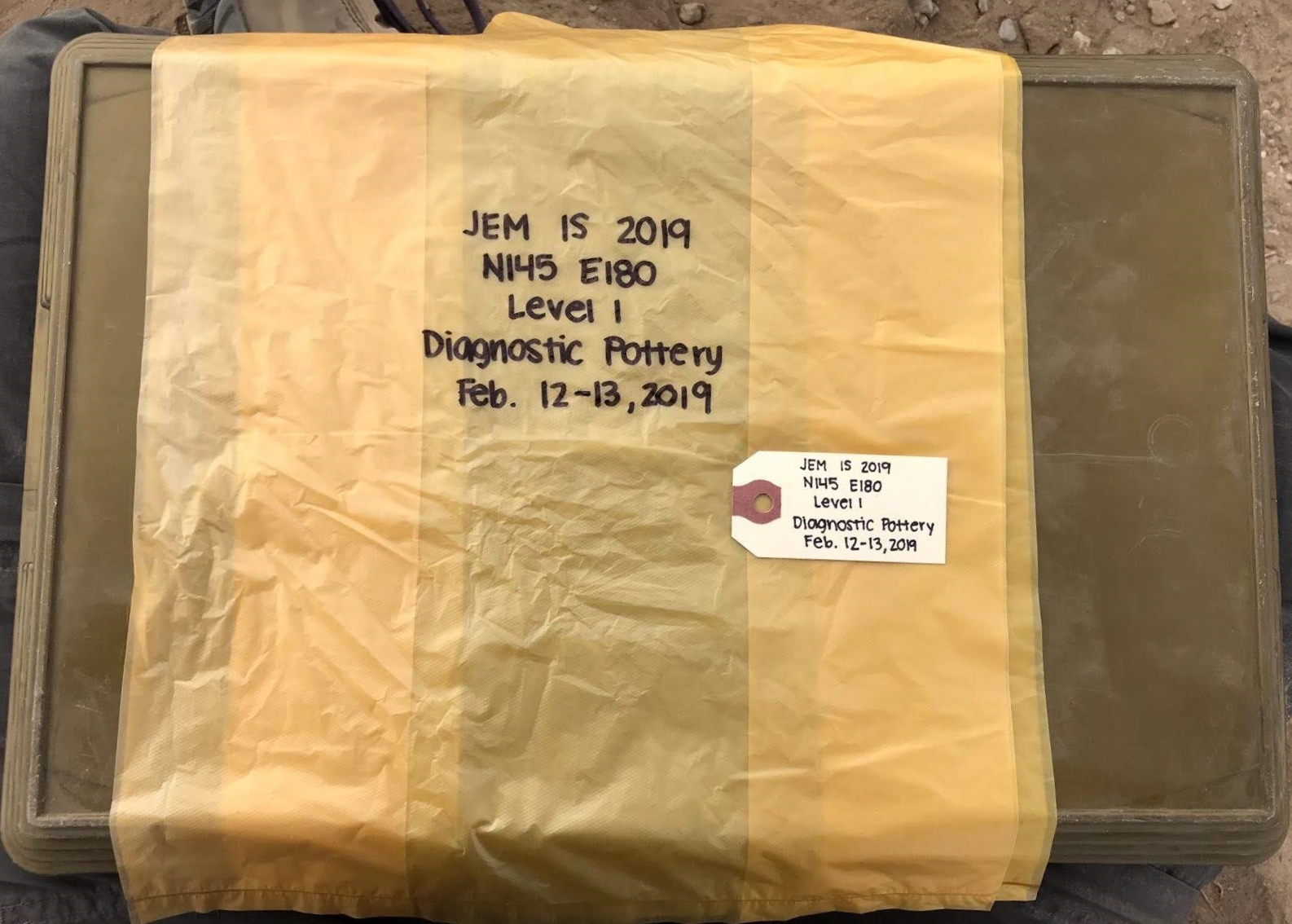
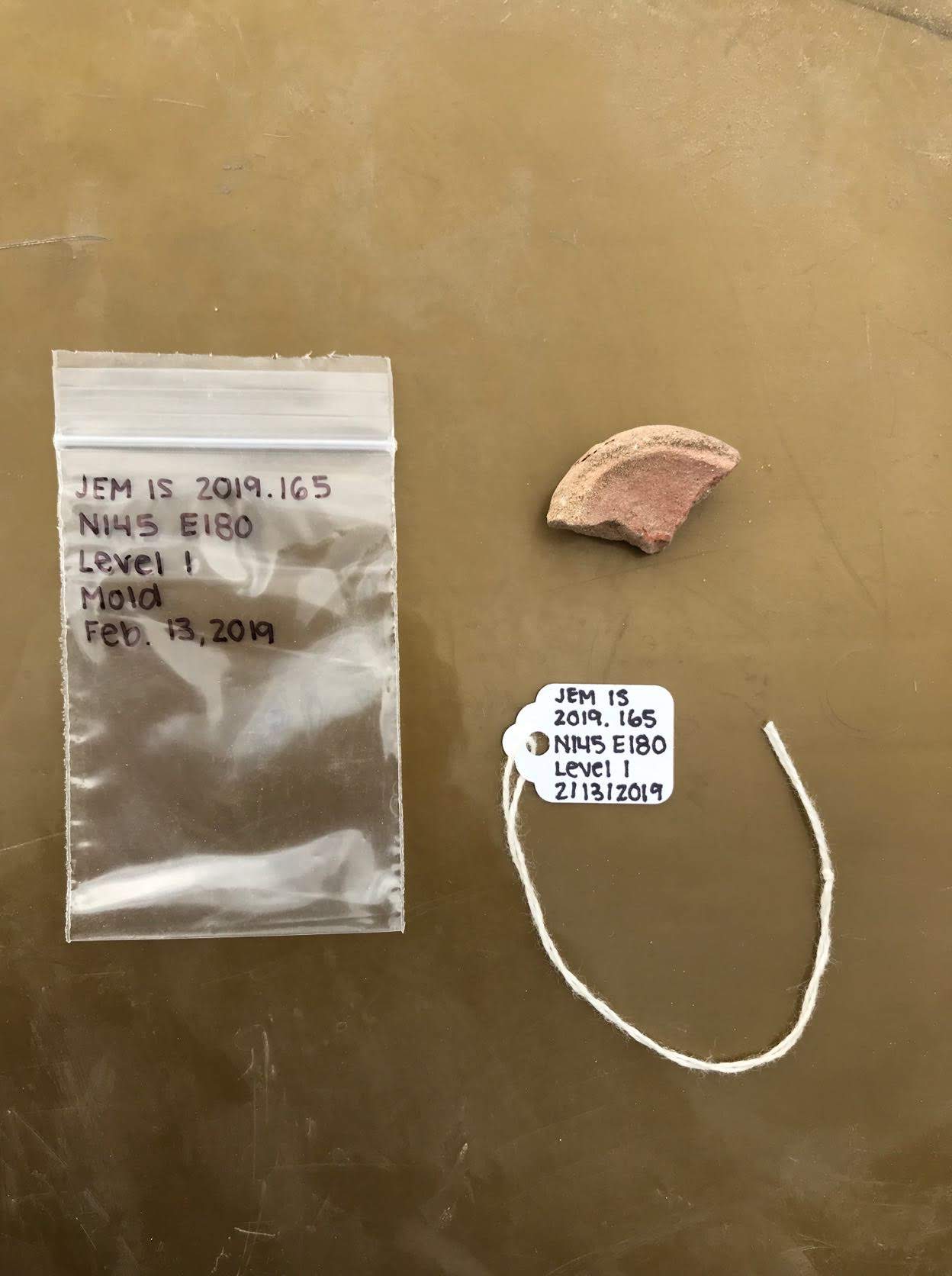
The manufacturing debris, or the excess raw material and product from production, is further divided by type. Remains of the same kind are put together in one bag with its contextual data written on the exterior. Every bag lists the site name; the year; the square number; the level, feature or locus number; the object type, and finally the date found. This process is duplicated for the objects, like beads, molds, and tools. These objects are also assigned a unique number. This number is very similar to the accession numbering system that is used at a museum like The Metropolitan Museum of Art. These artifacts are tracked separately from the manufacturing debris because they are recorded differently as they often tell us a lot more information.
Left: An example of a bag for diagnostic pottery along with its matching tag. Right: Fragment of a mold found during the 2019 season with its bag and tag.
Afterwards, a tag is created with the same data found the bags. These cards are then placed inside with the sorted material. Creating a tag may seem like an unnecessary and repetitive step, however, it is crucial. The material remains that are found during the excavation are only one aspect of the archaeological record. In order to properly interpret our finds, we need to evaluate them within the context in which they were found. It is therefore extremely important that we keep the findspot information with objects, as well as in our notes. Writing the information on the tag provides insurance that the provenance information will stay with the material in perpetuity. This is essential not only for the JEM’s research, but also for any future scholars who may work at Malqata.
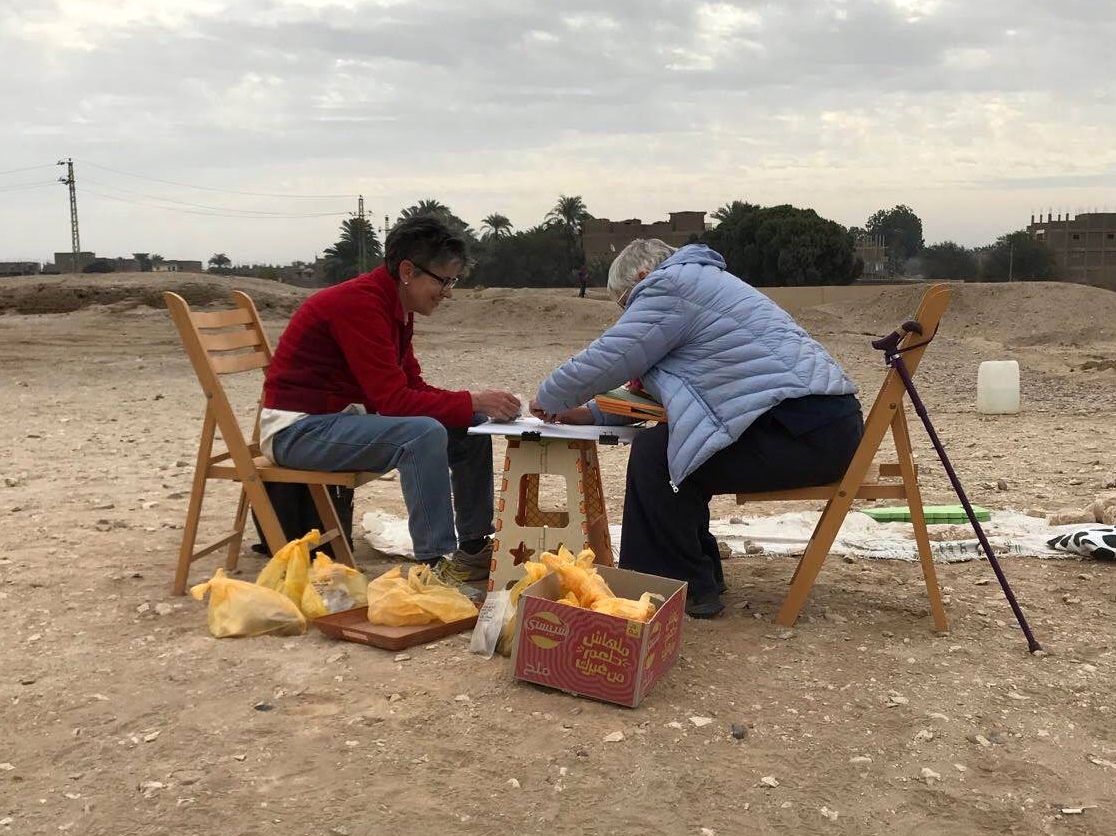
Once the objects are bagged and tagged, they are sent to Diana and Jan for processing. At this stage, they write initial descriptions about each find, as well as their thoughts about any correlation to glass and faience production. In addition, they record the weight of carnelian debris and take record photographs of the manufacturing waste. Subsequently, all of the objects are sent to Ivor for photography.
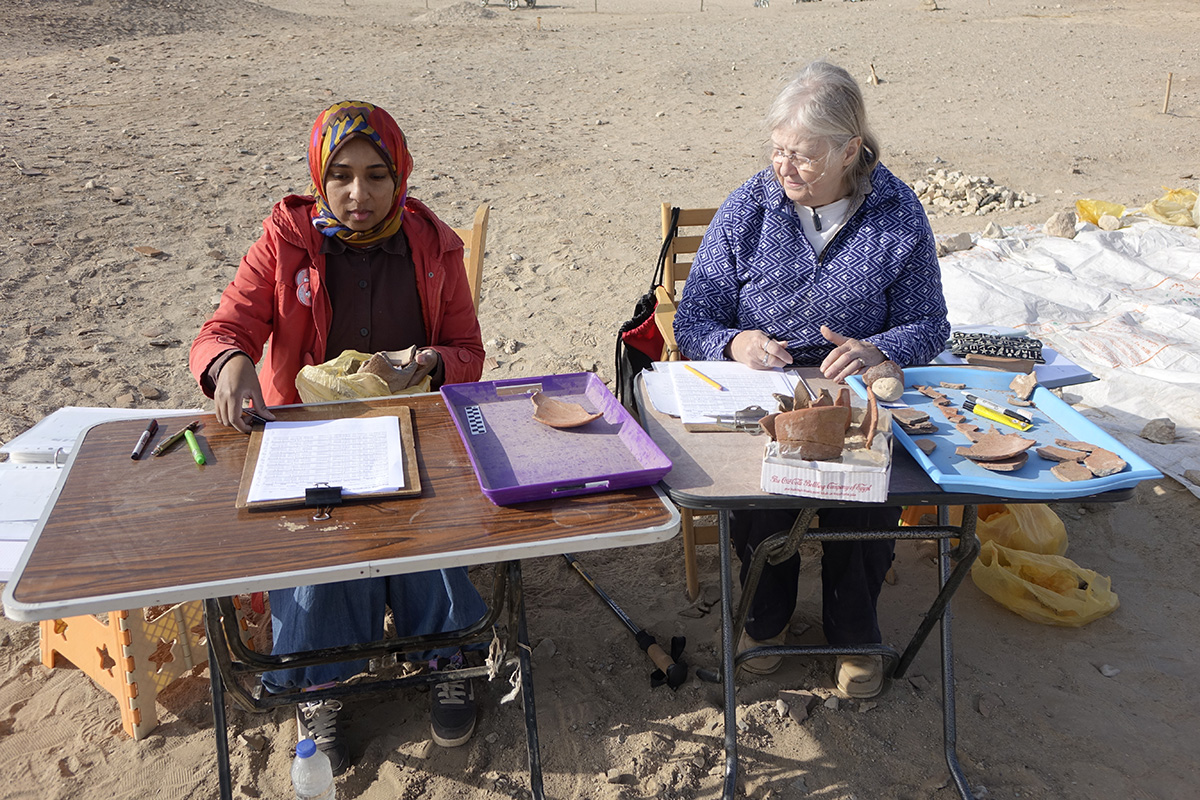
Right: Diana and Jan writing descriptions of the objects from the Industrial Site. Left: Ivor photographing objects.
Processing archaeological finds
does not stop there. At the end of the season, we will continue to analyze and
record information about each piece. In the secondary phase, Diana, Jan and I
will draw objects in preparation for the final report and for future
publications. Furthermore, all of the data collected will be transferred into a
FileMaker database that was designed by Janice specifically for the work at
JEM. Having a digital record of this data preserves an additional copy of our
work for the season. It will also allow Diana and Jan to continue working on
the material for publication outside of Egypt.
Diana and Danielle processing finds at the Industrial Site
Last year was my first at the West Settlement site of Malqata. I focused on developing record forms for the registration of each group of sherds found and another form to record the diagnostic sherds (rims, bases, handles, etc.). The purpose of both forms is to enable Janice to upload the pottery data collected into her database where it can be combined with other information from each square.
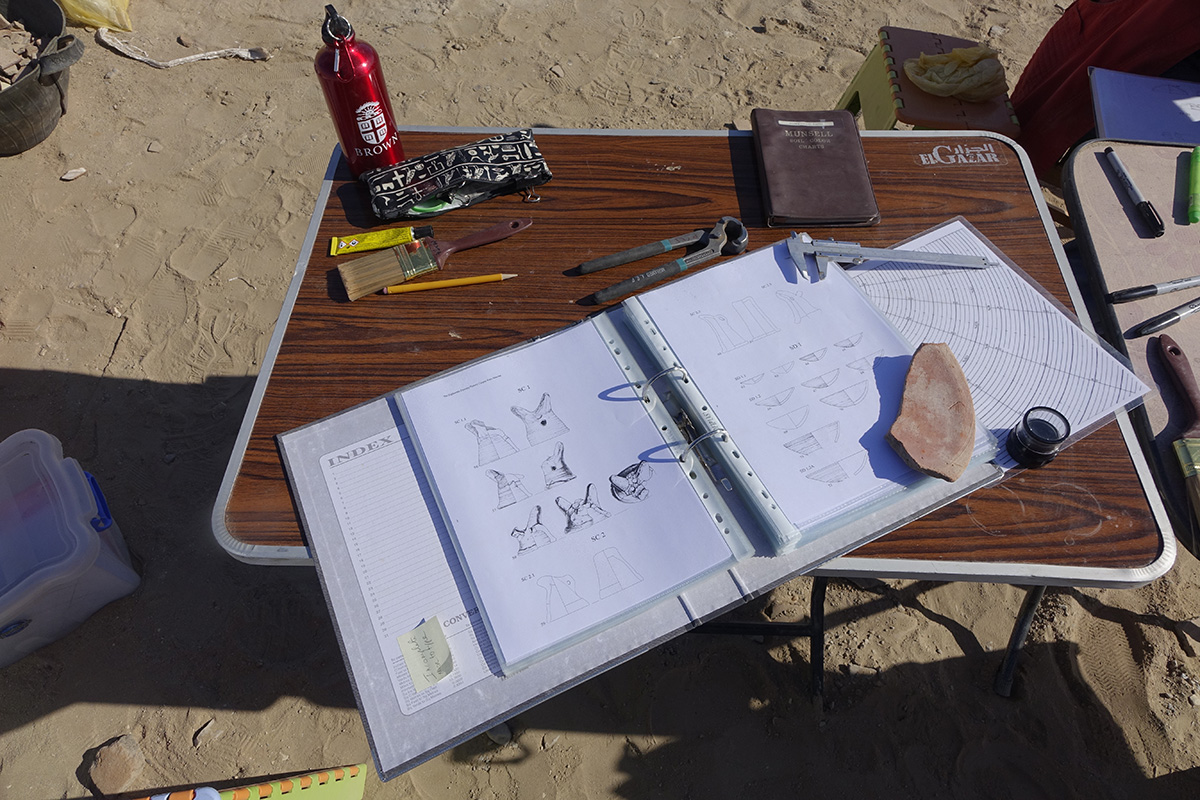
Our pottery notebook, with some of the tools of the trade
Having completed the initial sorting and recording of the pottery bags from 2016 last year, this year we began with the analysis of the diagnostic sherds. This is what ceramicists often call “typing” –that is comparing each rim or base to an established reference type; in our case we are comparing them to the pottery illustrated in The Eighteenth Dynasty Pottery Corpus from Amarna by Pamela Rose. This pottery is very close in date and purpose to that found at Malqata.
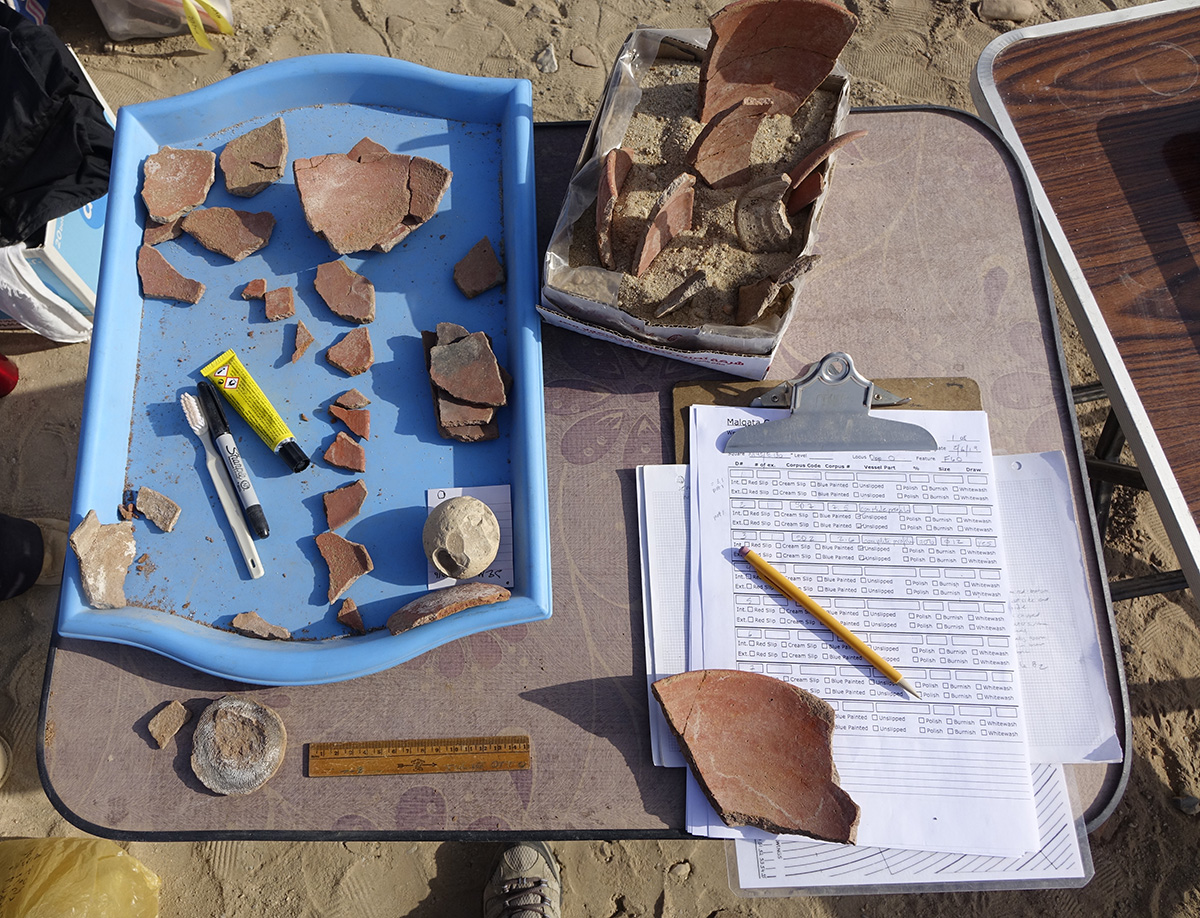
Gluing sherds in preparation for drawing their profiles
Each diagnostic sherd is then recorded on our new form, which includes additional information such as size and surface treatment. Sometimes they require a bit of sticking together and then being left to dry in our makeshift sandbox. Complete or nearly complete examples are set aside for drawing and photography so that we will be able to illustrate from our own material the kinds of pottery found in the West Settlement.
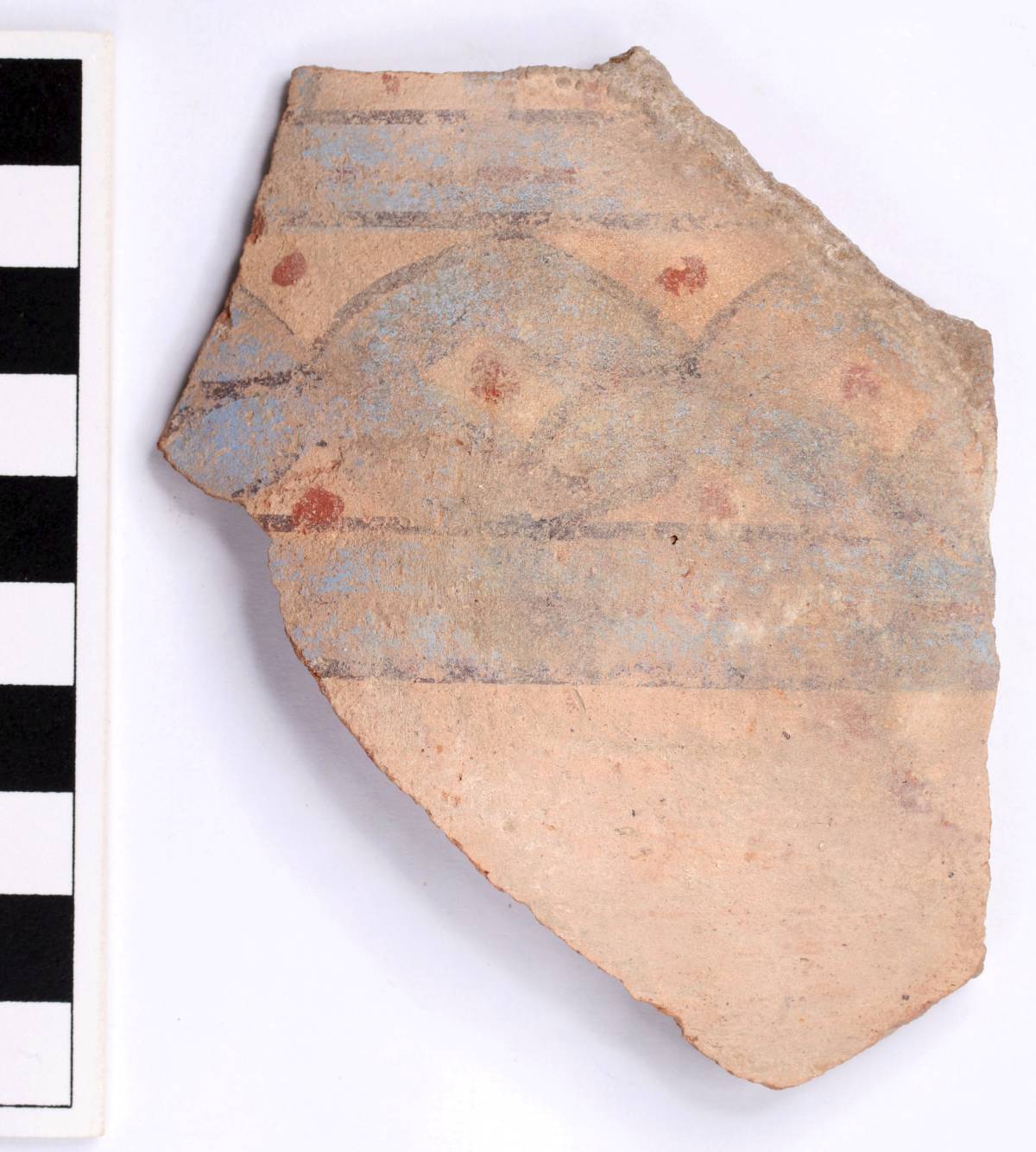
Who doesn’t love blue painted pottery? I certainly do, so it’s hard to discard non-diagnostic sherds to the spoil heap. When I found a large sherd with a pattern that I didn’t recognise I kept it with the diagnostics to check with Diana. Although produced from the mid-18th Dynasty through to the 20th Dynasty it’s difficult not to think of these vessels as ‘Amarna blue’ pottery. We all know the traditional repetitive lily petal motif because that pattern, with the decorative banded lines above and below, is the most common decorative scheme. Occasionally, you get the wonderful reliefs of Hathor or Bes on a vessel, or a freehand naturalistic scene of great artistry, but the lily petal motif is almost like a production line of limited variation. So when I saw the row of flattened oval circles it caught my attention. Diana agreed that it was a rare motif so I searched for comparisons both online and in the literature.
Blue painted sherd (JEMIS.2019.64)
Decorating cream slipped ware followed a
step-by-step process: first the ‘Amarna blue’ thick bands are applied, these
can be haphazard but our sherd is reasonably good. The four blue ‘leaves’ arranged
in a loose oval shape which form our basic design were probably done at the
same time while the blue paint was on the brush. Then black and red stripes were
applied. The four ovoids were probably outlined in black at the same time as
the blue bands were. It’s the black outline to each oval leaf that gives it its
definition and the four ovoids then make a distinctive flattened circle. The
red dots were probably added last (Rose 2007). The number of bands of
decoration depend on the size of the vessel. Only one band survives fully on
our sherd but there is an indication of another, different, decorative element
above the top stripes. Of course, we can’t tell for certain what shape the
vessel was but it seems possible that it was the traditional straight necked,
full bodied jar so familiar in these designs.
Even on our small sherd with only one
complete decorative motif, and a partial motif on either side with the stripes
above and below, it is possible to see how carelessly the preliminary blue
stripe and leaf pattern was applied before the black and red stripes and
outline were added to give coherence to the design.
This design does not appear in the Amarna corpus (Rose 2007) and the only similar motif I found after extensive searching was on Plate 8 of Colin Hope’s ‘Malkata’ corpus in his Pottery of the New Kingdom, so perhaps this is a design specific to the heb-sed festival site of Amenhotep III.
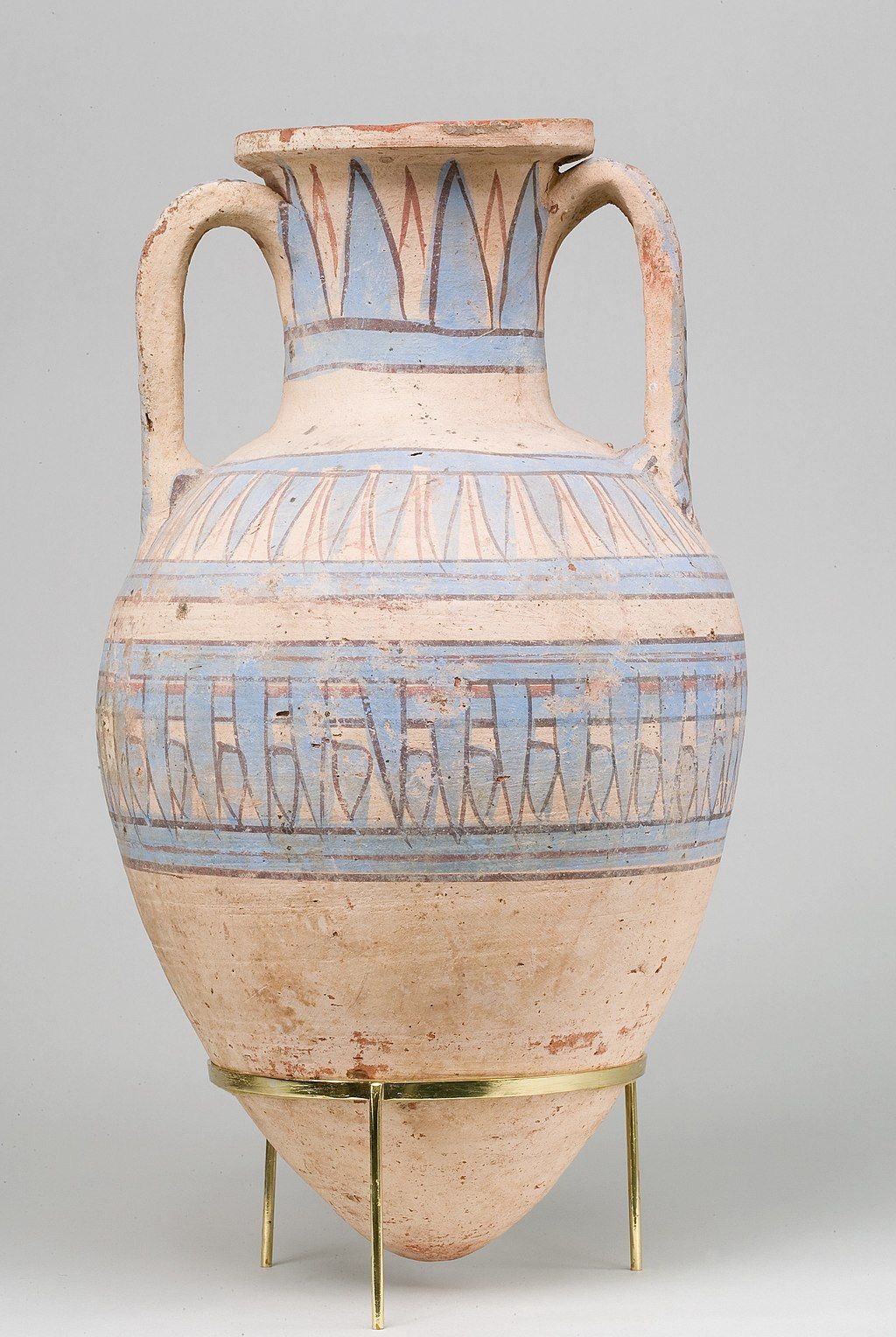
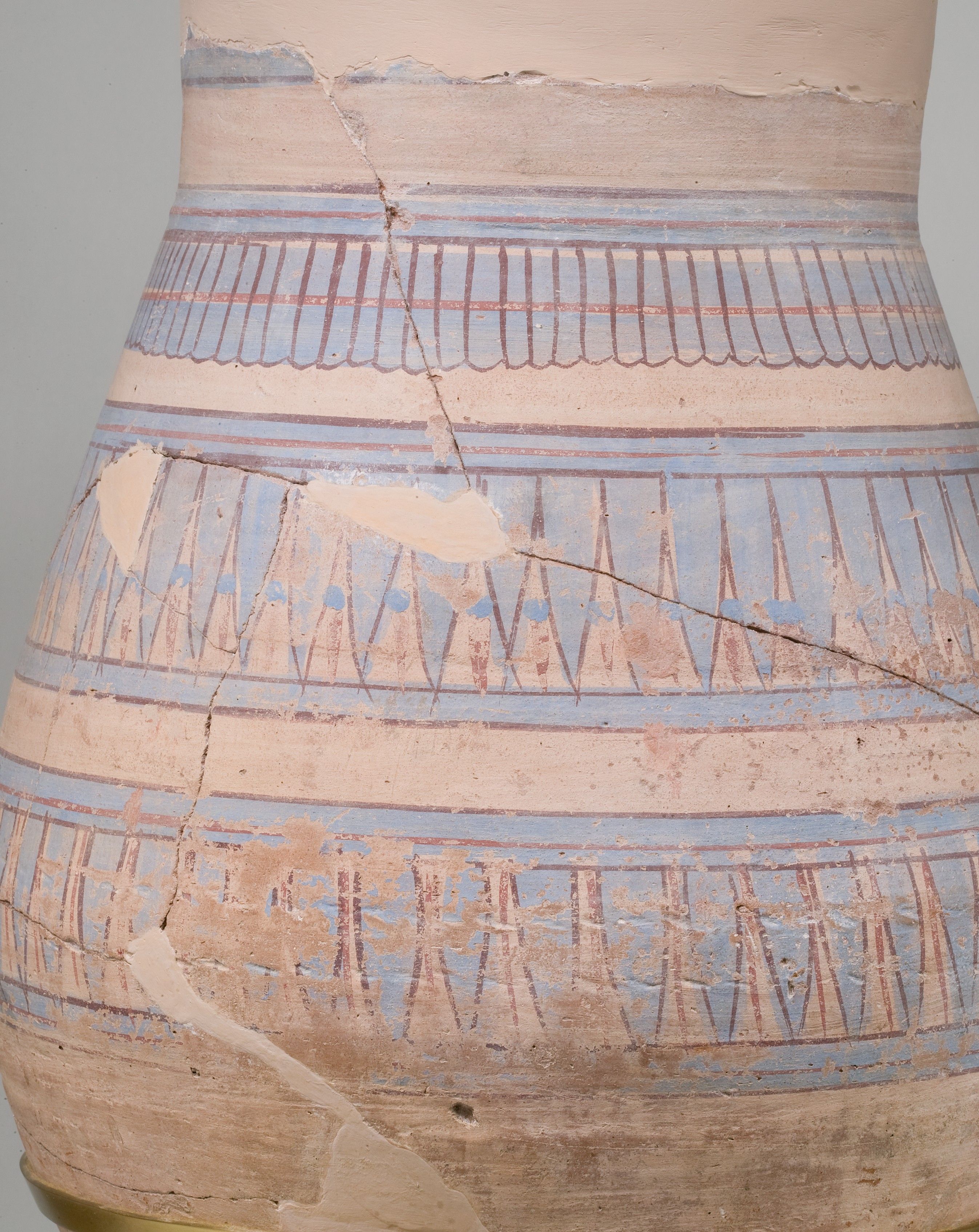
Blue painted amphora from Malqata, back view (The Metropolitan Museum of Art, Rogers Fund, 1911, 11.215.460)
Hope has suggested (1989) that the manufacture of blue-painted pottery may well have been a specialised activity and the work of only a few potters, indicated by the standardisation of the designs and motifs which were applied to particular shapes. The use of the blue pigment (cobalt aluminate spinel, probably sourced in the Dakhla oasis) in the colour scheme may further support the idea of a restricted manufacture, as the raw ingredients would not have been widely available.
Close-up of the decoration on a blue-painted jar from Malqata (The Metropolitan Museum of Art, Rogers Fund, 1912, 12.180.39)
The distribution
of blue-painted ware is found in large quantities only at Thebes and Amarna,
and later at Memphis with some found at Gurob and Saqqara. However, it must be
remembered that these vessels are containers for desired contents that are
shipped from one centre to another, so the find location does not necessary
indicate the place of manufacture.
However illustrious the context of our
sherd it still seems to agree with the rule that blue painted vessels were mass
produced and decorated by rote on a wheel or turntable. This may come as a
shock to lovers of ‘Amarna blue’ pottery.
Hope, C. A. 1989. Potteryof the Egyptian New Kingdom – ThreeStudies. Burwood.
Rose, P. J. 2007. The Eighteenth Dynasty Pottery Corpus from Amarna. Egypt Exploration Society Excavation Memoir, 83. London.
In the West Settlement, my first task at the beginning of the season is to decide where to excavate next. We talk about it at the end of the previous season, and make some tentative plans, but I continue to think about it as I finish processing my notes and photographs. And then I always try to arrive back at Malqata with fresh eyes.
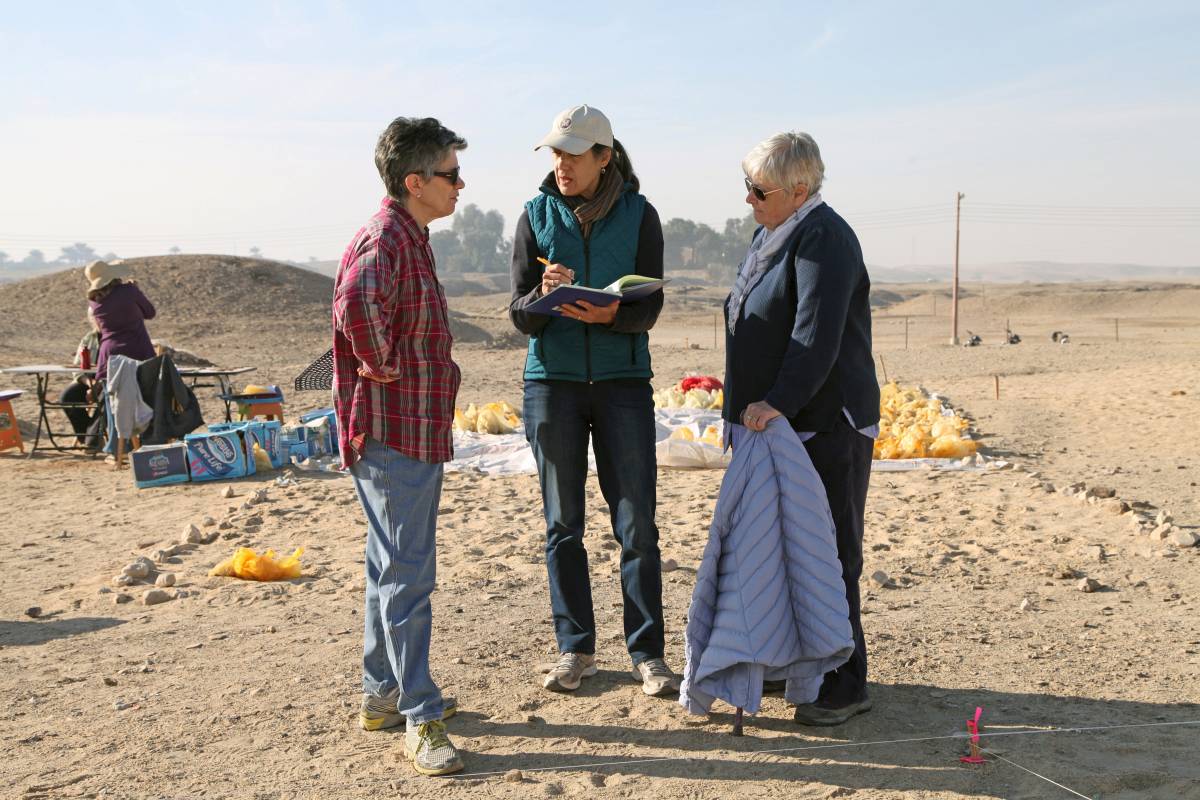
Consulting with Diana (left) and Jan (right)
Some of my priorities for this season are to continue to clarify the footprint of the site, and to see how it relates to other areas. On the east (local north), we are interested in seeing how the West Settlement connects to the Industrial Site where Diana is working. In order to explore the latter question, I am moving in that direction, but in 2.5 meter trenches rather than full 5 meter squares, since it is possible (in fact, likely) that we will be going through the wadi that has washed out any traces of the settlement to the north (see What Lies Beneath). We can’t go too far to the east or we will hit the old Met spoil heaps, but we will go as far as we can.
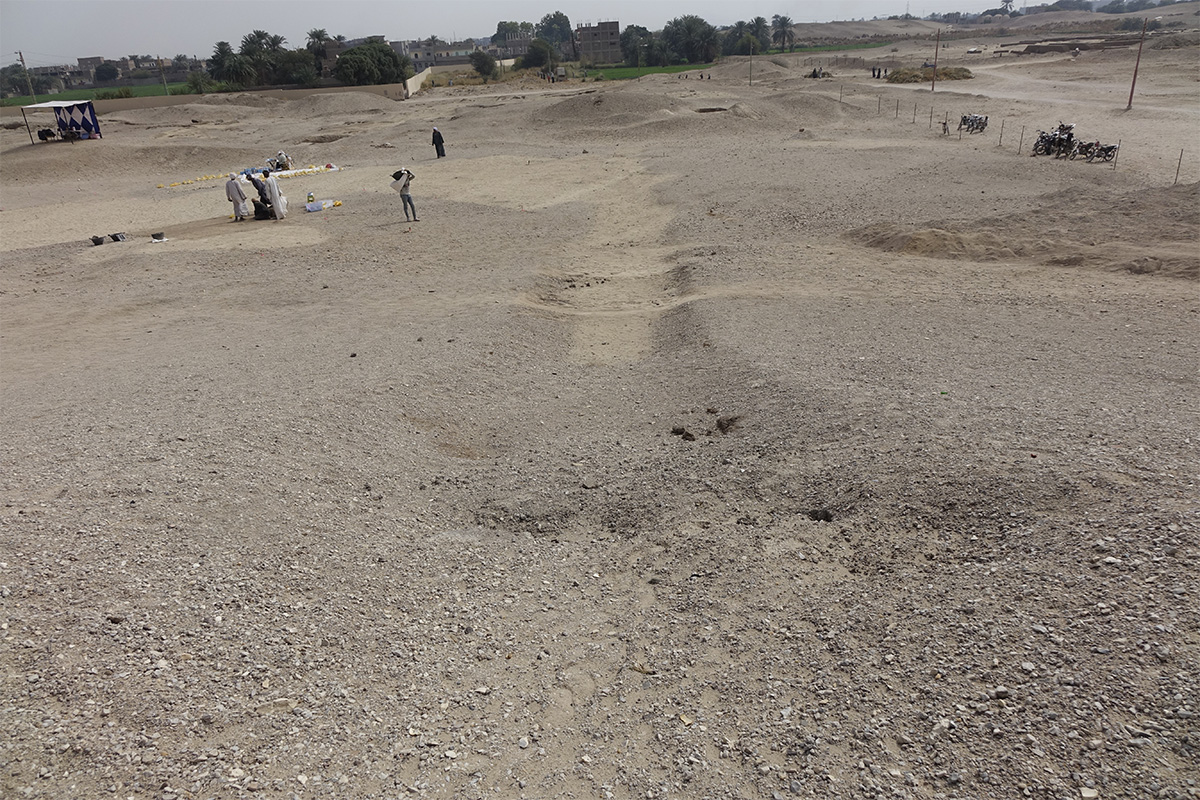
Looking southeast down Trench P (backfilled) toward the current West Settlement excavations
To the west, we are interested in seeing if we can connect the current excavations to a series of partial foundations uncovered in “Trench P” by Barry Kemp a number of years ago. Dr. Kemp has been so kind as to share information from his forthcoming publication of this work, so we know that his walls line up with ours, and that that one of them continues the thicker wall (laid in headers rather than stretchers) that seems to serve as the boundary of the settlement.
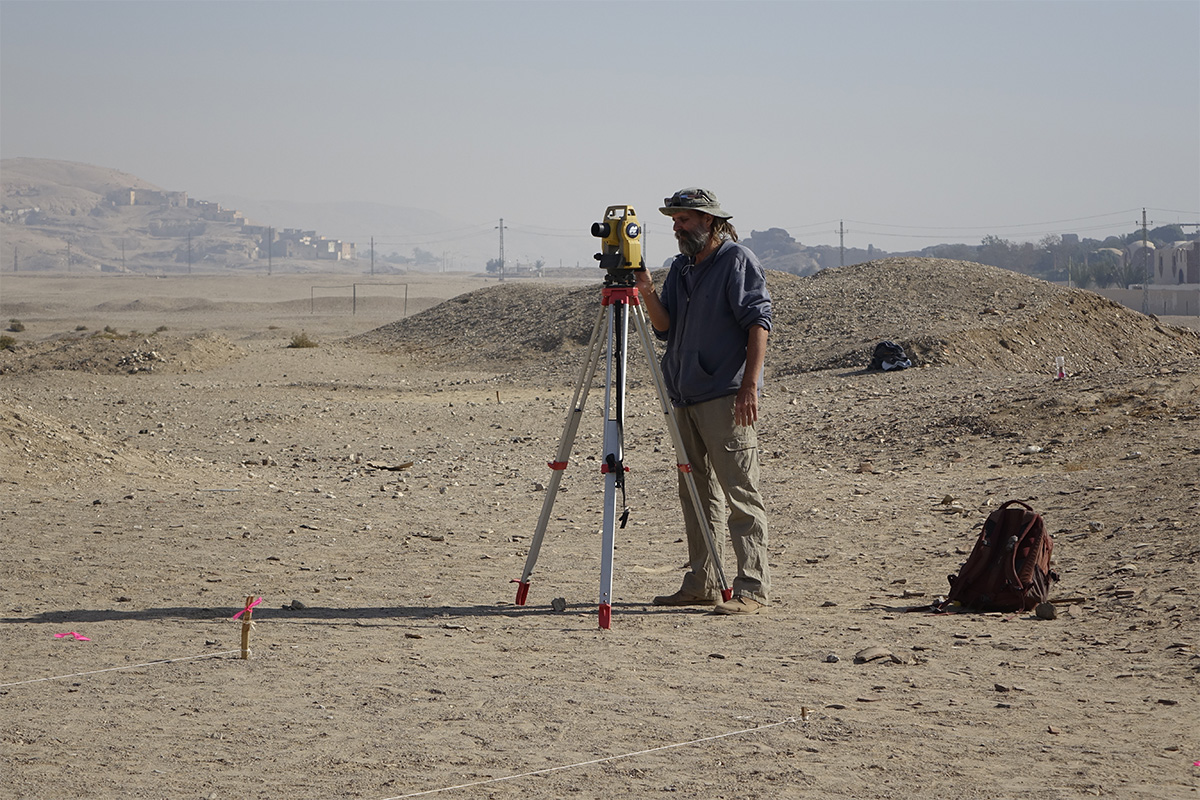
Piet shoots in some new points on our North-South grid
Our surveyor, Piet Collet, has helped to lay out new squares to both the east and the west. We are stringing them up and getting to work, so stay tuned!
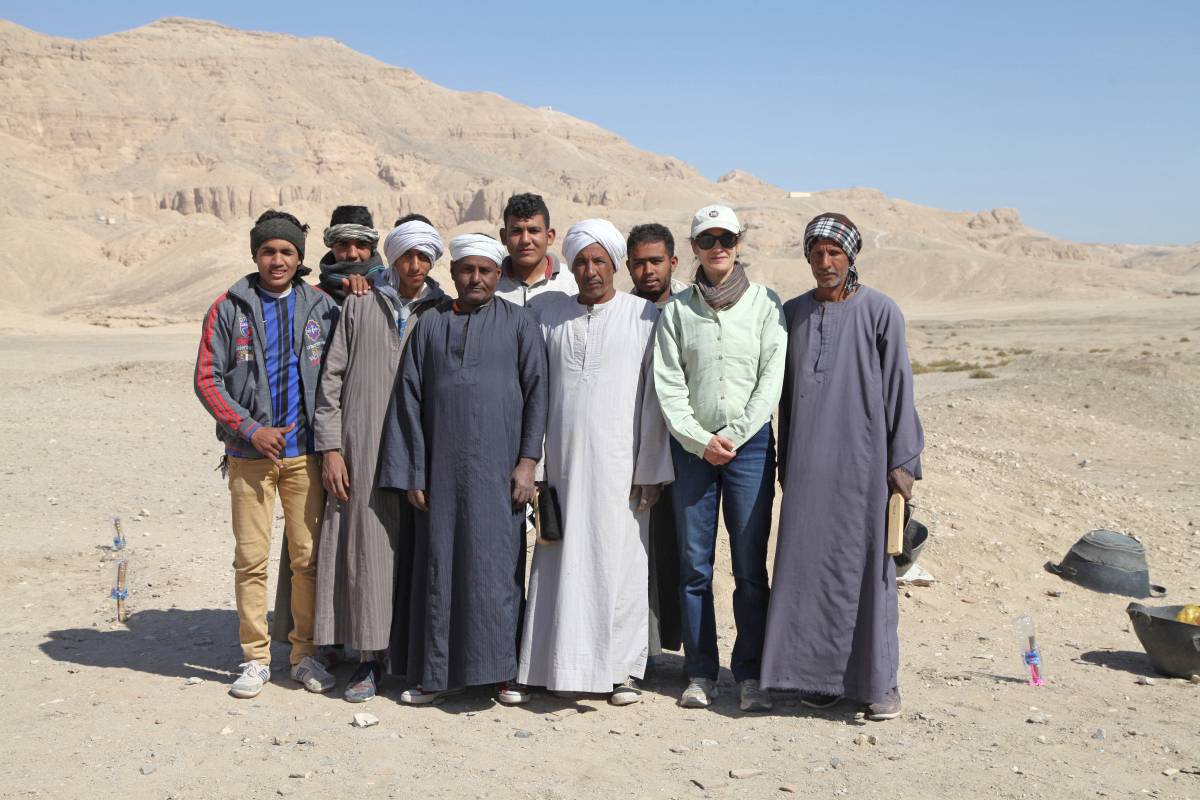
The West Settlement Team: (L to R) Ali Mohamed Ja’allan; Hassan Horagi Mohamed; Mohamed Abu-ez Mohamed; Sa’ad Tagi Ahmed (senior excavator); Ossama Mishra’i Megala; Ja’allan Mohamed Said (senior excavator); Khaled Hassan Khodari; Janice Kamrin; Mahmoud Mohamed Hassan (senior excavator)
When you work in Egypt, part of the process of getting into
the field is signing the contract that allows you to work at your site. This step is carried out in the office of the
Head of Foreign Missions of the Supreme Council of Antiquities (SCA) in Cairo. For me, signing the contract is very serious
business because when my signature as expedition director is added to the paper I accept the responsibility of an important site, Malqata, for the period of time I am working there.
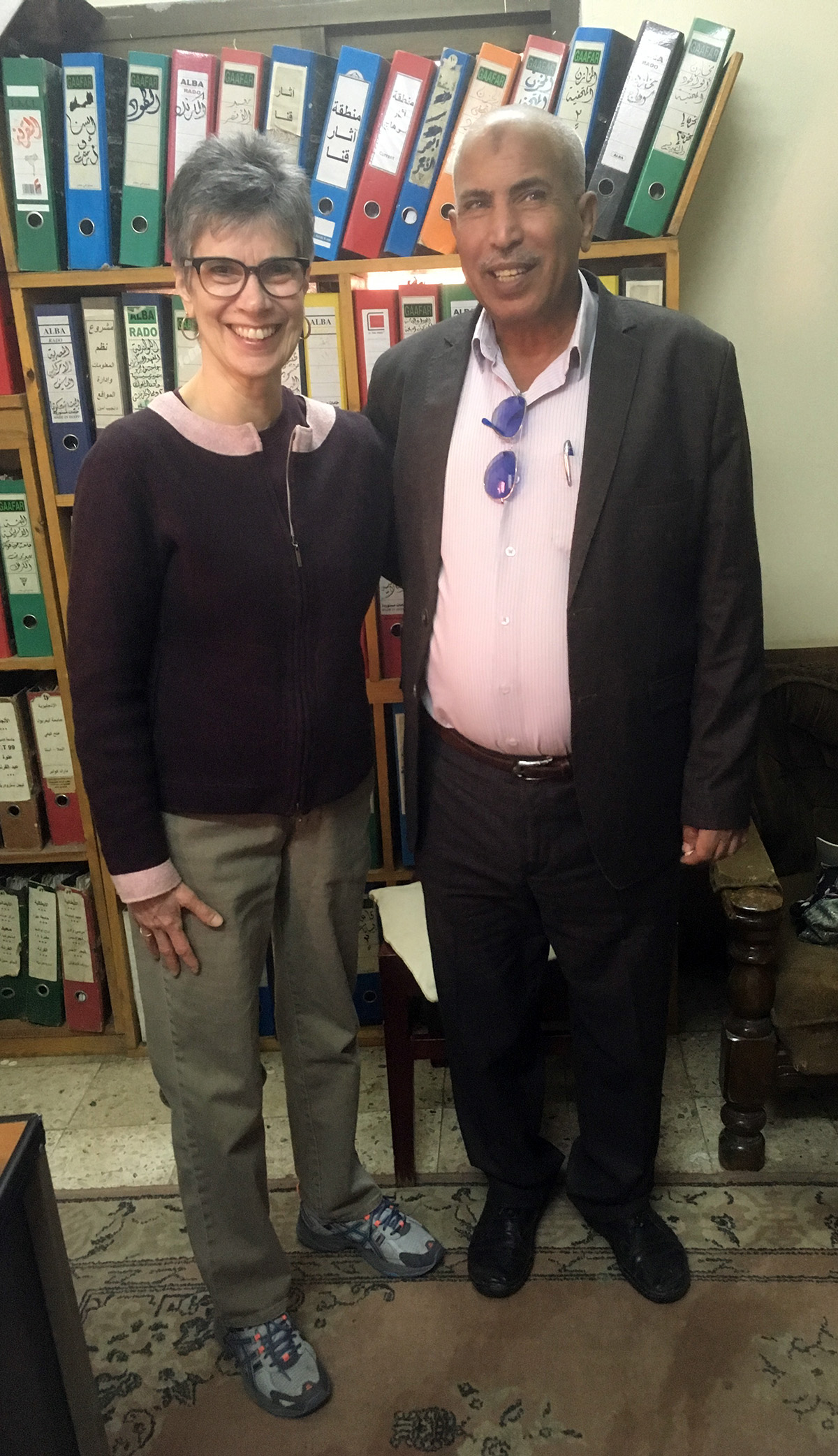
After receiving the contract, I take this agreement to be approved at the local level, which for Malqata requires signatures from the Luxor and West Bank inspectorates of the SCA. This season I was the last mission to have its contract approved in Luxor by the former General Director of Upper Egypt, Dr. Mohamed Abdelaziz, who retired last Monday. I have known Dr. Abdelaziz for many years because he served as the General Director of the West Bank inspectorate for three of the seasons (2012-2014) we have worked at Malqata. In this position, Dr. Abdelaziz was in charge of what could take place at Malqata during the excavation, so we were in regularly contact each year. I always found him welcoming and helpful in supporting the work at our site. By 2015, he had been promoted and we no longer saw him on the West Bank, but instead greeted him in the East Bank office, although we saw him much less often.
Diana Craig Patch and Mohamed Abdel Aziz in the East Bank office.
Now that he has retired, the team working at Malqata will miss a good friend, but we wish him all the very best in the coming years and hope he will come to visit us.

 iMalqata - A Joint Expedition